Local to global comments in three languages. Much also from Pitäjänmäki Sockenbacka in Helsinki Helsingfors Finland, as well as from the organisations I participate in. The older content is from my previous blog page which I have now closed. Most of the contents on the earlier pages deals with sustainability, human rights and social responsibility in the global supply chains.
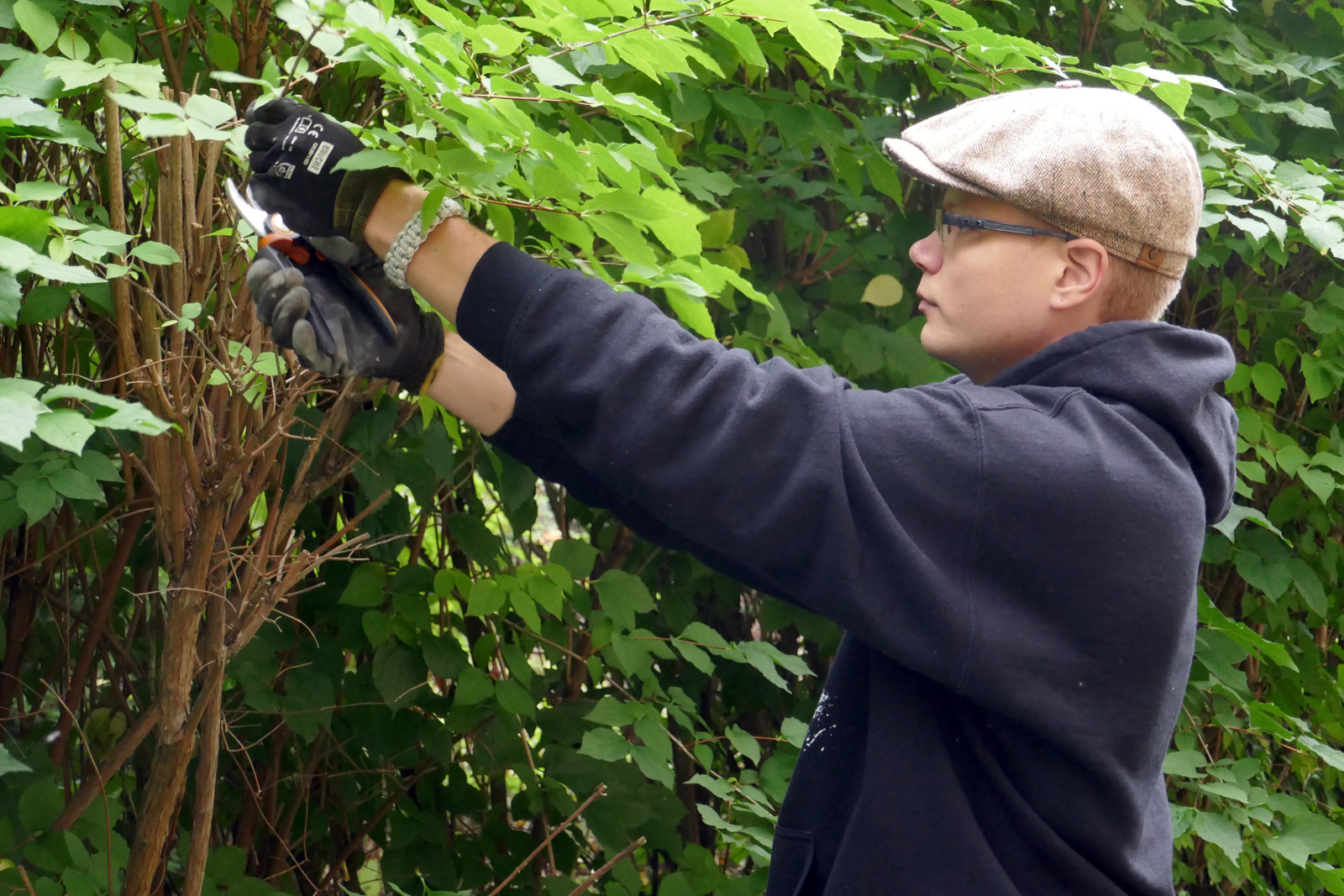
Today we started a new service in my city region Pitäjänmäki – Sockenbacka for the elderly and for families who need assistance. Our new village assistant will be available to help with chores both in homes and in gardens. This will bring much relief to many. We are not competing with the private sector but providing a social service in the neighbourhood.
This initiative by the regional residents’ association Pitäjänmäki-seura which I am president of is made possible by the Finnish government. To enable long-term unemployed to get back to work, organisations like mine can apply for support from the public employment authorities. If all conditions are met they will pay the full wages for up to one year, instead of paying unemployment insurance compensations. We handle all administration and booking ourselves, and can thus keep the hourly fees paid by customers very low.
So today, Akseli started his work with us. Next autumn he plans to pick up his university studies again. There are many elderly people living in our villages so I am sure that he will be busy.
To support both local employment and provide useful social services is an important function for our association.
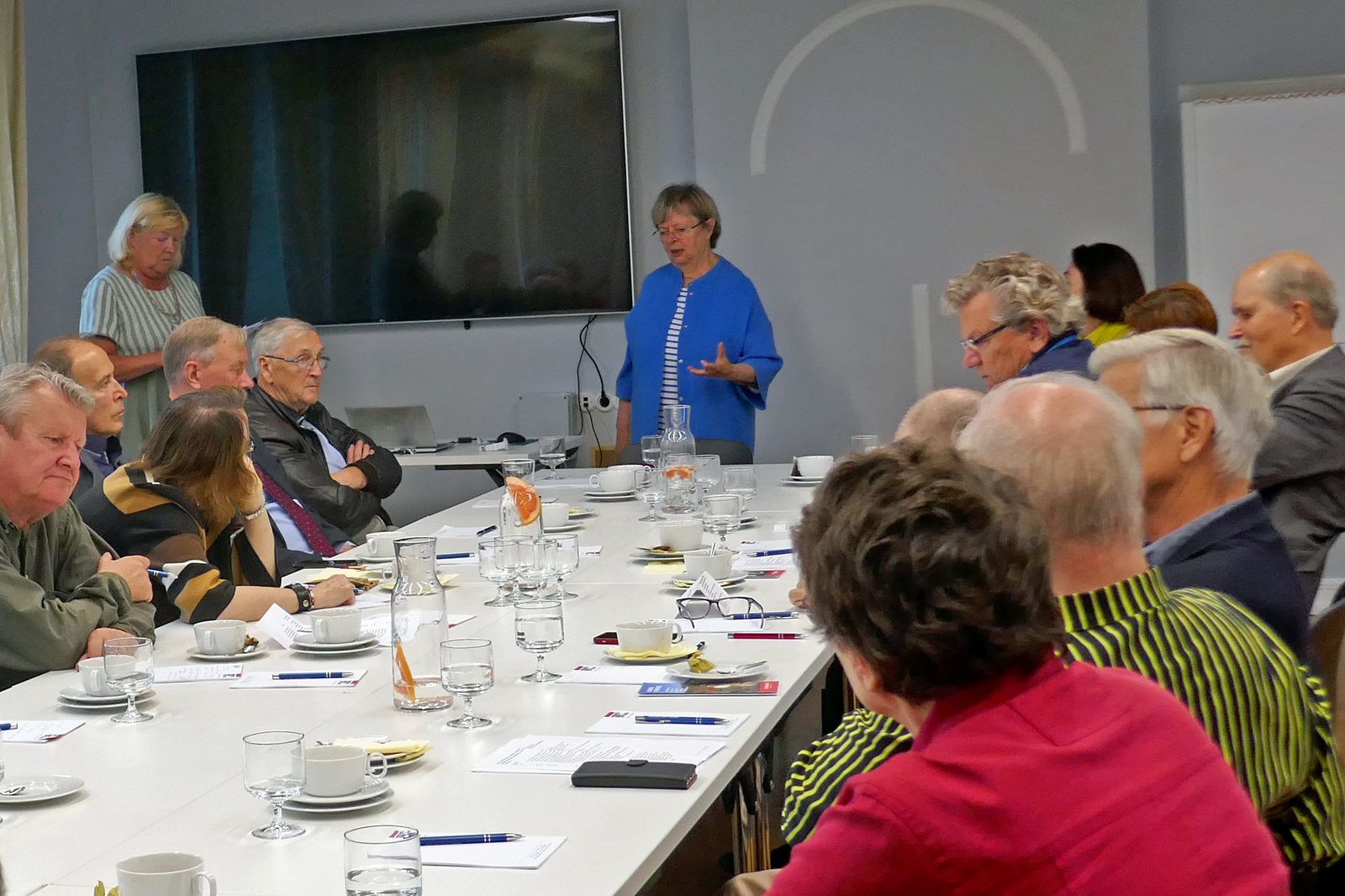
The one-day meeting was attended by Estonian social democratic veterans from all parts of the country. The ten Finnish participants represented the two Wanhat Toverit social democratic veterans’ associations in Helsinki as well as the national association.Liisa Jaakonsaari, former member of the European Parliament, commented the EU from the Finnish point of view.
Brexit has helped convince people that the benefits of being part of the European Union are indeed important.
Today popular support for the EU is growing almost everywhere. As global structures and rules are under pressure it is important that the EU preserves its unity as a community for peace and freedom.
The European Union was a central subject when social democratic veteran politicians, civil servants and full-time reps from Estonia and Finland met yesterday (Wednesday 11.9.) in the Estonian capital Tallinn. From Finland, a small group representing the Suomen Wanhat Toverit association participated.
Main speaker from our side was Ms Liisa Jaakonsaari who recently retired from the European Parliament and did not stand for re-election. She was member of the Finnish parliament and Minister of Labour. For the Estonian participants, Mr Ivari Padar gave a presentation. He is Member of the European Parliament and former Minister of Finance, Minister of Agriculture and former chairman of the Estonian Social Democratic Party.
The speakers said that it is regrettable that there are EU Member States which want to break down basic European values. The rule of law, freedom of the press, academic freedoms and human rights are being violated in countries like Poland and Hungary. It is unacceptable that common values are not respected.
Responding to wishes from the European Parliament and European Commission, the Finnish EU Presidency is keeping these issues high on its agenda, Liisa Jaakonsaari told participants.
Growing right-wing populism was an important subject at this Estonian-Finnish social democratic get-together. Estonian Member of Parliament (Riigikogu) Ms Heljo Pikhof told about the many incidents where the top leaders of the populist EKRE party have been attacking the country’s democratic institutions. The Estonian Presidency and the person of President Kersti Kaljulaid have not been spared, but on the contrary been given special attention. This the EKRE leaders have done even from their present positions as members of a conservative coalition government. The social democrats positioned themselves strongly against EKRE in this year’s parliamentary elections but had to see their numbers go down.
Speakers and other participants stressed the need to actively present democratic alternatives to many of the concrete questions that the right-wing populists have chosen for their agendas. It was suggested that this could be one of the important subjects when the Estonian and Finnish social democrats develop their cooperation further.
Mr Kari Salmi’s presentation of the new left-centre government in Finland as well as the ongoing Finnish health care reforms raised much interest among the Estonian participants. He is chair of the national association that brings together social democratic veteran activists, Suomen Wanhat Toverit. In the lively discussion that followed we could see both the many similarities between Estonian and Finnish approaches as well as important differences.
Walking to the Tallinn mansion that housed our meeting we had the opportunity to visit the new monument raised in remembrance of the Estonian victims of communism and communist state terror. It gave a strong impression to go up the hill between two gigantic walls of black stone with all the names of the 12,256 people deported in 1940-41, 11,080 politically imprisoned or murdered 1940-43, 35,472 deported 1944-53 including those 32,990 deported in 1949, and the 49,347 politically imprisoned or murdered between 1944 and 1991.
Speakers and participants in the discussion stressed the need to actively present democratic alternatives to many of the concrete questions that right-wing populists have chosen for their agendas. It was suggested that this could be one of the important common subjects when the Estonian and Finnish social democrats develop their further cooperation.
With two former Finnish Ambassadors to Estonia, Mr Jaakko Blomberg (2001 to 2005) and Mr Jaakko Kalela (2005 – 2010) as members in our group we were well briefed about the political backgrounds.
I participated in the meeting as president of one of the two veteran social democratic activists association of the Finnish capital Helsinki, Pääkaupungin Wanhat Toverit.
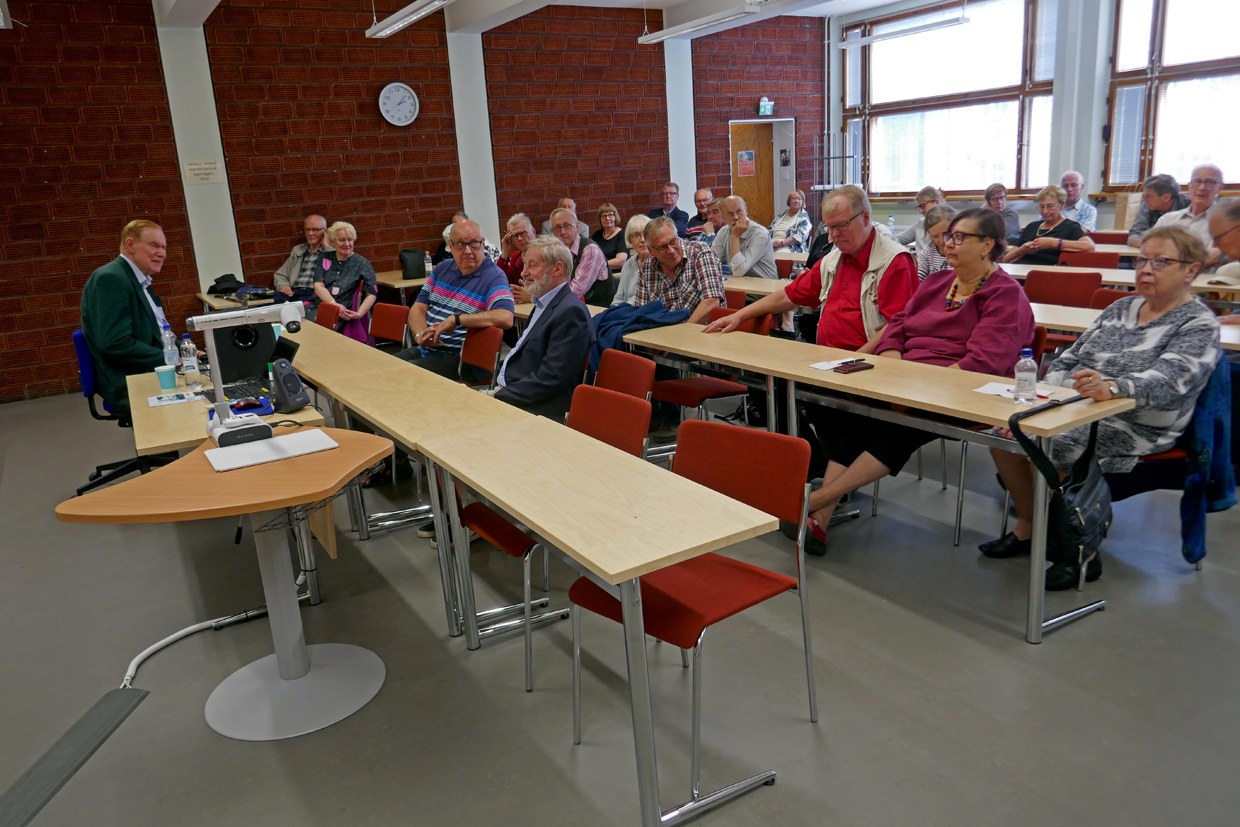
Highly interesting discussion today ( 3 September 2019 ) when Finland’s former Prime Minister and Speaker of Parliament Paavo Lipponen visited the social democratic veterans association which I am president of. His role in bringing our country into the core of European Union integration was absolutely crucial. Today some 50 of us former full time activists listened attentively to his analysis of the truly fateful years for Europe and the world that we are living through now.
Paavo Lipponen covered much subject matter in what was almost a lecture, from the rise of authoritarian rule and the hardened global climate over growing inequality, the spread of anti-semitism and racism, concluding with the need for an intensified cooperation within the European Union. The EU needs to play a stronger role. Further strengthening of the European monetary union EMU is part of the necessary measures.
There was a clear consensus in our group that we cannot just stand on the side-lines and watch extreme right wing groups and ideologies spread in different parts and countries of Europe. We have to take the lead away from these circles on issues where they are now allowed to dominate. This calls for speaking fearlessly out for our own values and standing up to these dangerous movements that are putting humanity and democracy at risk.
Almost 50 years have gone from when Paavo Lipponen often took the same city bus as I did, on the way to our neighbouring offices in Hakaniemi-Hagnäs in Helsinki. At times Paavo came on board of Bus 17 two stops after mine and we could have a brief chat during these 15 minutes on the road. It was fun to refresh the memories of far back early morning rides – we both indeed left very early for work.
When I welcomed Paavo Lipponen and told our friends that in my view, he did play a historical role in securing Finland as a European western democracy with a Nordic welfare state orientation there was clearly a broad agreement in the room. Here I believe he has placed himself alongside some of our most important social democratic leaders of the 20th Century, such as Väinö Tanner, Karl-August Fagerholm and Mauno Koivisto.
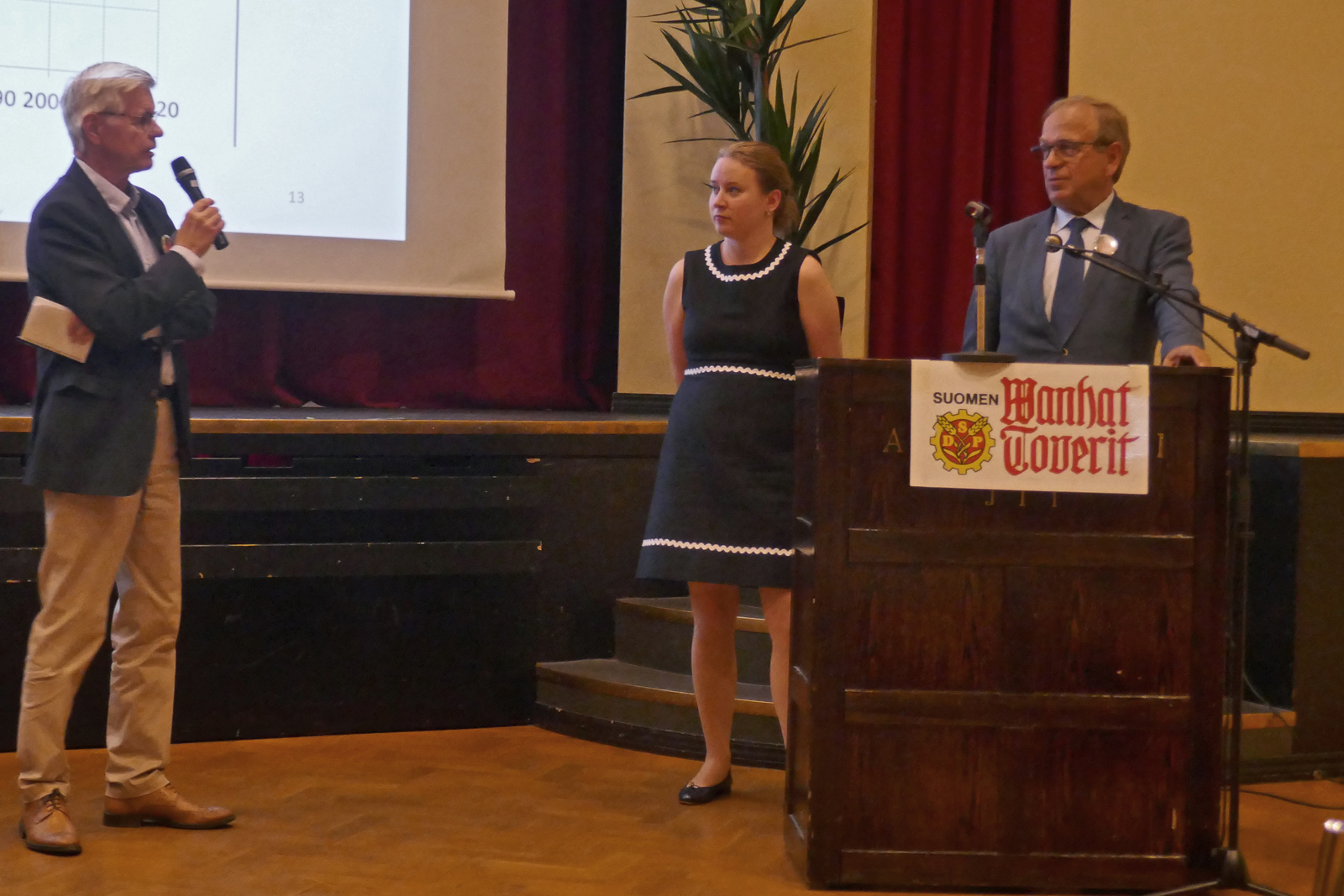
Ilona Lahdelma and Erkki Liikanen being interviewed by Kari Salmi, President of Suomen Wanhat ToveritErkki LiikanenSocial democrat veterans met in Jyväskylä in August 2019
We may not be the youngest but we surely have our sights set on the future. And also some really great memories that came back again, from my student activist days in the late 1960’s. Nice moments with old friends and colleagues.
So I am back today from a two-day meeting of the Finnish social democrat veterans association, Suomen Wanhat Toverit. Three hundred we were who came together in Jyväskylä in central Finland on 24 – 25 August 2019. This is an association that brings us together, mostly at local monthly meetings, but every two years at these larger national events. I am an active member there, chairing one of the two local organisations in the Finnish capital, Pääkaupungin Wanhat Toverit.
We met at the Jyväskylä Workers’ Hall, one of the early works of famous Finnish architect Alvar Aalto. Here we were treated to two exceptional presentations about the future of European democracy.
During his long career in politics, Erkki Liikanen was Finance Minister, Member of the European Commission and then Governor of the national bank, and much more. This gives him a unique vantage point on how democracy in Finland, Europe and the world has developed through many periods of challenge and turmoil. In his highly interesting and engaging presentation he raised major challenges but also pointed at positive developments in Europe and the European Union. Tackling marginalisation and improving education have to be among the important tasks on the agenda. The support for the European Union is stronger than ever in many member states which is also a cause for optimism.
Young political scientist Ilona Lahdelma who is working on her doctoral thesis at Oxford University complemented Erkki Liikanens lecture in a way which opened up the subject of democracy itself and offered an attempt to a scientific analysis of some main trends on the European political scene. Her views on how traditional political divides have changed all over Europe was highly interesting. We were also very attentively listening to how political movements must take account of the effects of the new media landscape on voters’ expectations and behaviour.
Meeting old colleagues and friends is a major function of these conferences. All of us have been active in different professional or political roles within the social democratic labour movement. At a dinner which the City of Jyväskylä invited us to old friendships were confirmed in a very pleasant atmosphere. Once again I could feel the benefits of being this pretty small country where our relations tend to be so uncomplicated.
I enjoyed particularly much my long chat with Erkki Liikanen on the train to Jyväskylä. Upstairs in the café wagon it was nice and quiet, almost empty, except for us laughing now and then to some of the common memories from our youth years. Fifty years back we both worked together in the national secondary school student’s organisation Suomen Teiniliitto. This was the central point for Finnish student activism in the late 1960’s – we were in fact often more active and radical than the university students’ associations.
For the first time I heard – I think – Erkki telling me that I was the first Swedish-speaking Finn whom he had ever met. His home town was Mikkeli, in south-eastern Finland, a completely Finnish-speaking region.
We did of course talk about many other things and about today’s world, but this flashback that brought up many nice and even funny incidents and memories was really enjoyable. I could of course write page up and page down on what we were up to during those wild 60’s, maybe I soon will…
In December 1906 the Bengtskär lighthouse was taken in operation.
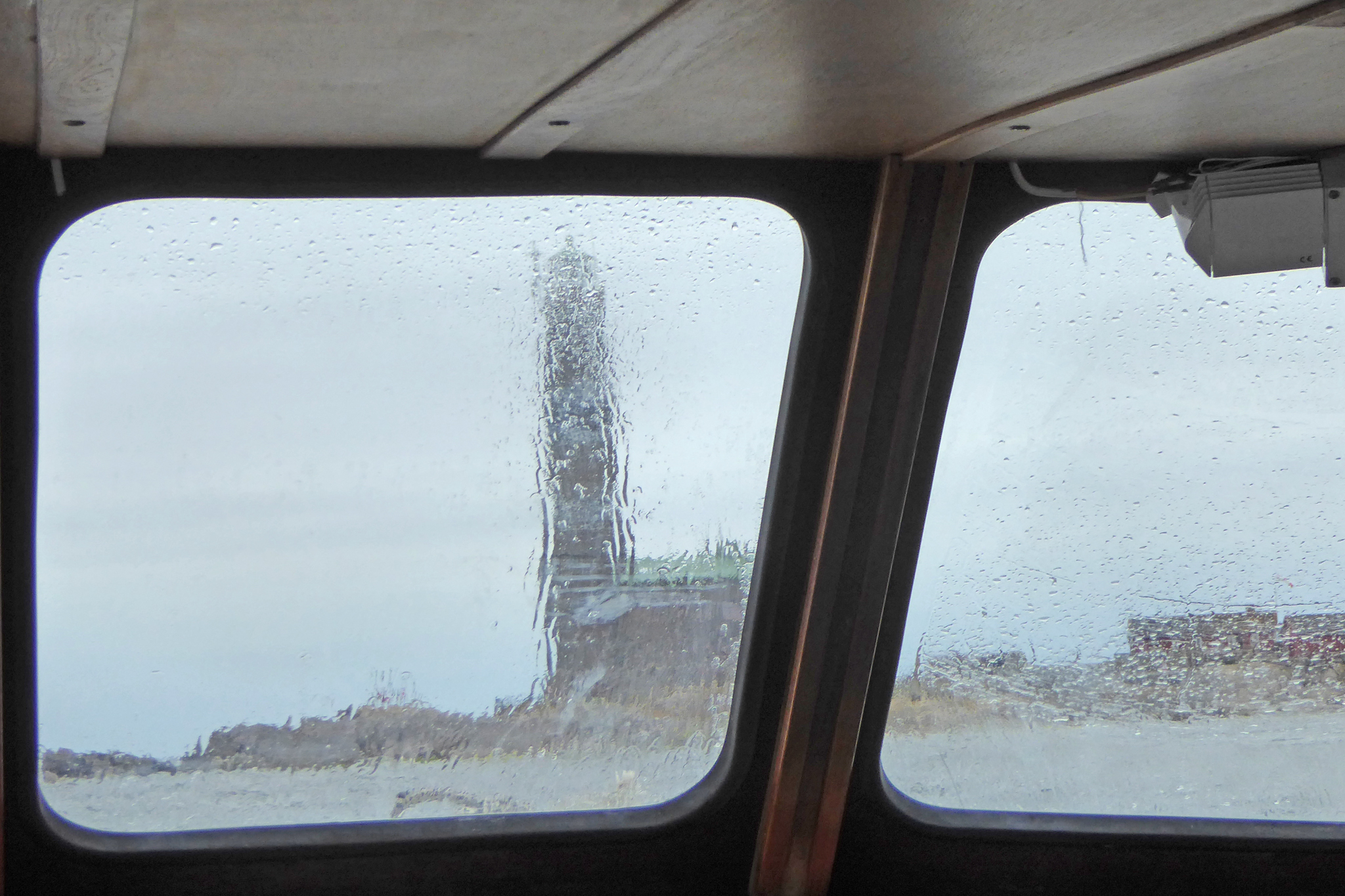
Finland’s long coastline has many treasures which invite to great outdoors experiences. One of them is Bengtskär, home of the tallest lighthouse in the Nordic waters. On a windy day in June 2019 we visited this historical site just over 100 kilometers west of Helsinki, the Finnish capital.
The lighthouse was built around the turn of the 19th and 20th centuries. The rugged cliff where the Bengtskär lighthouse stands is the southernmost of a myriad of small rocks and islands. Before its construction, this part of the northern shore of the Baltic Sea and Gulf of Finland was plagued by shipwrecks.
The scene of a particularly violent but failed attempt by Soviet troops to take over in 1941, Bengtskär is a natural, architectural and historical site at the same time.
In 1939 the Soviet Union attacked Finland which started the Winter War as we call it here. Against all odds this small country was able to fend off the take-over attempt but was forced to cede territory to the much bigger enemy. The coastal town of Hanko (Swedish: Hangö) had to be ‘rented out’ as a naval base which was set up in March 1940.
After a brief period of peace the war flared up again in the summer of 1941, also as Finland wanted to regain some of the earlier losses. The light tower at Bengtskär was used by the Finnish artillery for leading the fire of their nearby base as well as the navy and air force and thus the Soviet troops wanted to eliminate it.
A small museum in the lighthouse building ells the story of this violent battle in July 1941.
In the early dawn of 26 July, shielded by bad weather, four ships from the Hanko-Hangö base arrived at Bengtskär and landed some 120 elite soldiers. The small Finnish garrison was able to force the attackers to hide behind the large rocks on the island and they were for many hours unable to proceed to the lighthouse building itself.
Finally, the Finnish soldiers had to retreat to the higher levels of the tall building. Poorly armed, they stopped the first attempt by the attackers to force their way up the spiral staircase by throwing down the only hand grenade that they had. This caused a break in the fighting which allowed troops from the nearby Finnish coastal artillery station Örö to land on the other side of the small island. The Soviet troops finally had to retreat both from Bengtskär and from their naval base.
The battle over Bengtskär cost 32 Finnish soldiers their lives. The Soviet losses were probably much bigger although exact numbers have never been given out.
This grey and a bit rainy day was much more peaceful. Some 60 to 70 visitors had arrived there for a few hours, by taxi- or sight-seeing boats. We were guided around in three languages – Swedish, Finnish and English – and had a chance to stroll around on our own. The cliffs on this tree-less island were steep and slippery but the beautiful outer archipelago flora was more than worth a careful inspection walk.
Bengtskär is also a unique refuge for the eider birds and as you can see from the pictures there were still many female eiders ( Swedish: åda, Finnish: haahka ) in their nests quite close to the buildings. These birds are not shy of people and this does in fact protect them against the birds of prey at sites like Bengtskär. Some of us who have been around for quite a time know that the best pillows were always made with eider down – ejder dun in Swedish.
With the whole Baltic Sea opening up around Bengtskär it is far from easy to traffic this rocky little island when winds are strong and the waves are high. The ‘harbour’ or actually the berthing place is reached through narrow straits through the smooth but treacherous cliffs.
I was impressed by our boat driver and his skills, a young man from one of the islands in this archipelago. I also talked much with him about how life is here today. Many traditional small industrial sites have closed down and jobs are more scarce today than they used to be.
It takes an hour and a half by taxi boat to get to Bengtskär from the island village Rosala, a legendary holiday site in this Swedish-speaking archipelago.At the natural harbour of Bengtskär.The Moomin Troll mascot is watching over the taxi boat’s passage through cliffs and rocks in these stormy northern waters.
Still, I am happy we went there on Wednesday with its 7 m/s winds, on Thursday they were up to between 13 and 17 m/s.
The southern archipelago is a part of Finland where Swedish is the majority language, an important region for our national minority. This is also why Bengtskär does not have a Finnish name but is just called Bengtskär, in Swedish.
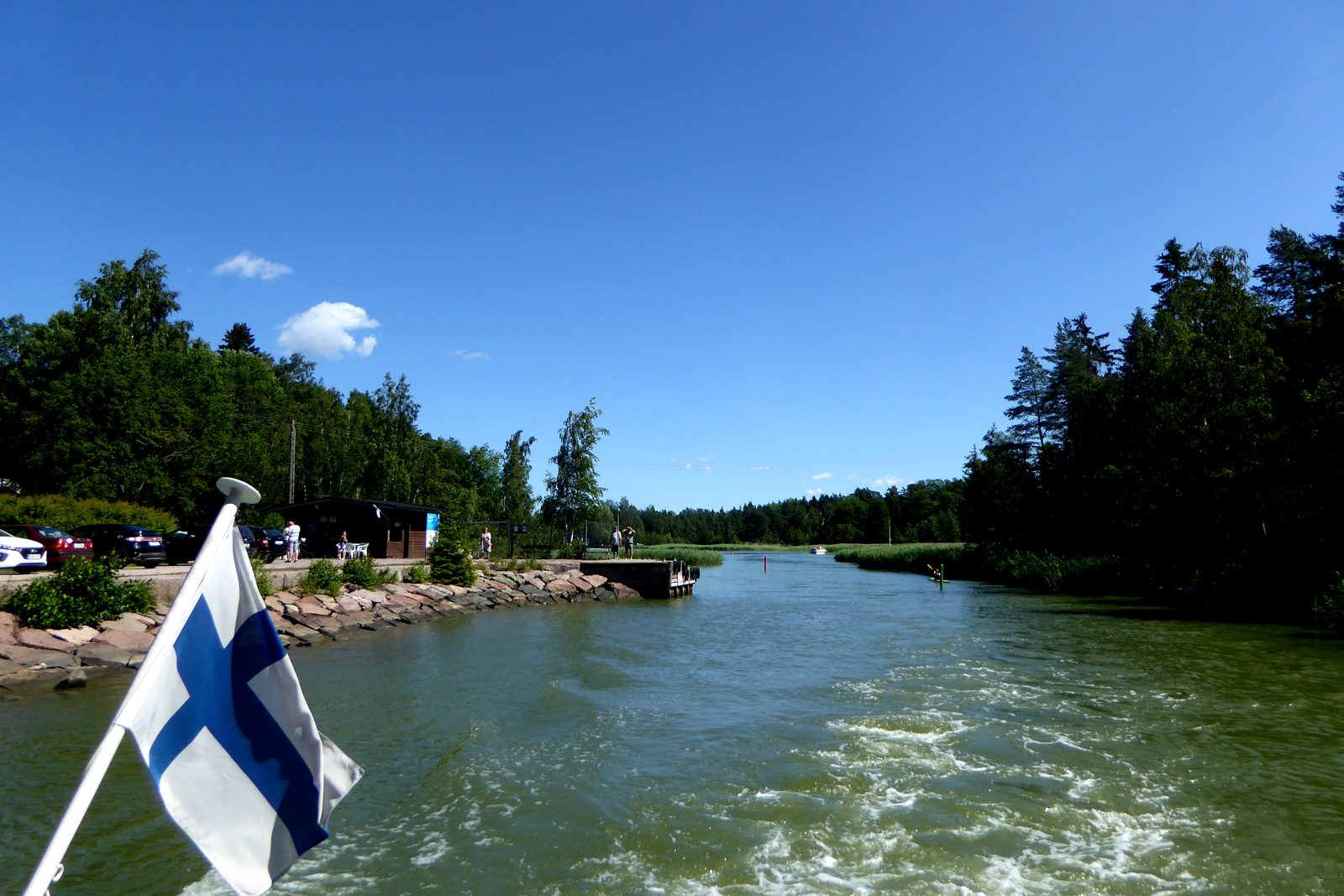
A beautiful summer Sunday (23 June 2019) – and what could be better than to get out on the water. This time we went to the archipelago just west of the Finnish capital Helsinki – Helsingfors. We took the tour boat from a suburban marina in Finno which brought us to the Pentala island in about an hour.
The island world just outside the Helsinki metropolitan region is quite fantastic and today it showed its most beautiful face.
The route was a bit nostalgic for me as this was where we used to head westward for weekend trips with my parents’ slow wooden cabin boat. Later, when I was about 14 or 15, we were allowed to go alone, with friends. Often we berthed for some days on one of the many uninhabited islands, most with superb red cliffs at the sea shore, smoothed by the ice age. The water was clear and the swimming great.
Later, with our own family, we had a small summer house a bit further west. Today we remembered the stormy weather and the agitated sea on the open stretches when we took our small cabin boat there for the first time. Our luck I guess was that it was a slow Norwegian dinghy kind of a boat, made to roll on top of the waves…
Today’s tour was of course different, like taking a bus but still right out there in the fresh air and clean nature. We wanted to see a new museum on the island, an old fisherman’s homestead. It is owned and managed by the municipality, with free entrance, and the boat trip there and back costs 6 Euros. If you are retired – age does not matter they said – you pay only 3 Euros, sponsored by our next door neighbours in the Espoo – Esbo municipality.