ESTONIAN – FINNISH MEETING OF SOCIAL DEMOCRAT VETERANS STRONGLY SUPPORTIVE OF THE EU

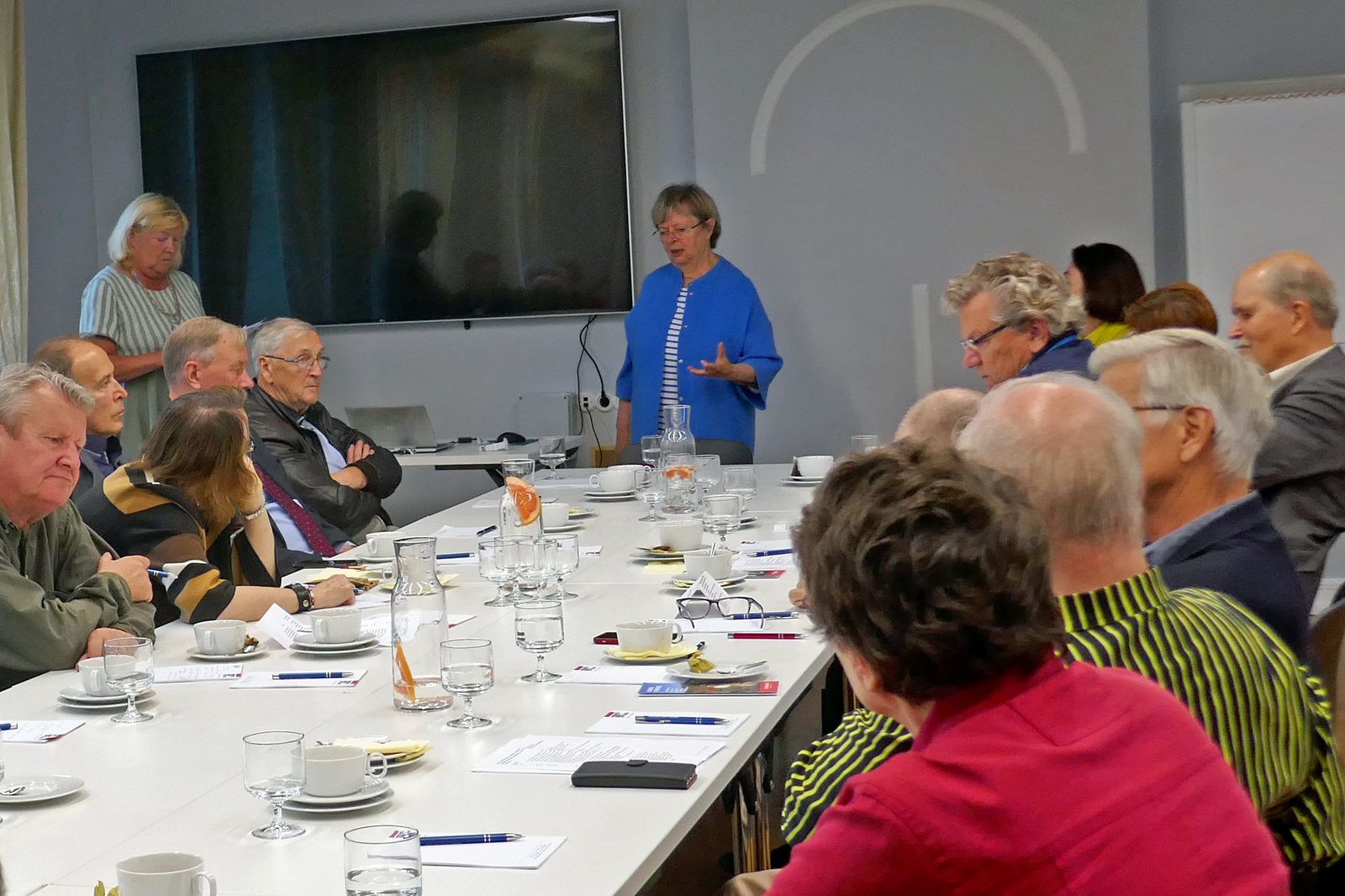
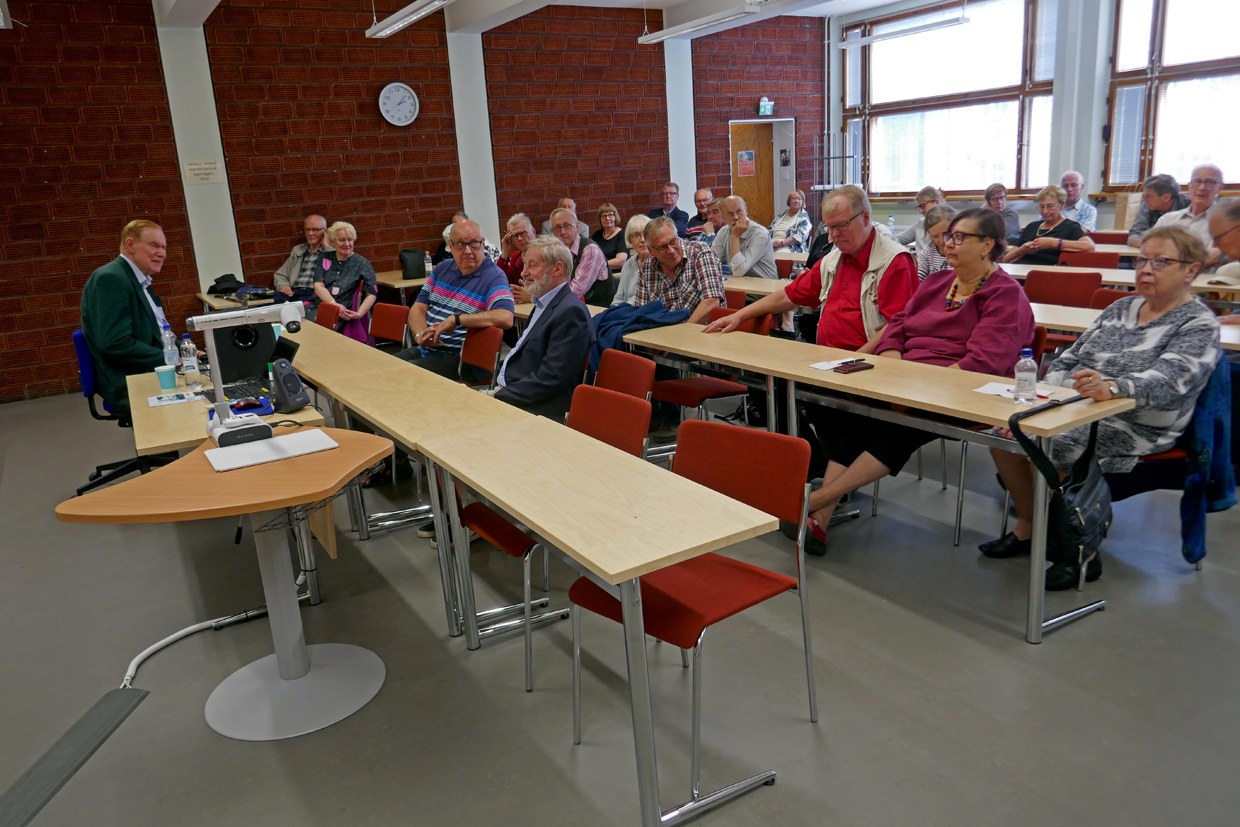
The one-day meeting was attended by Estonian social democratic veterans from all parts of the country. The ten Finnish participants represented the two Wanhat Toverit social democratic veterans’ associations in Helsinki as well as the national association.
Liisa Jaakonsaari, former member of the European Parliament, commented the EU from the Finnish point of view.

Brexit has helped convince people that the benefits of being part of the European Union are indeed important.

Today popular support for the EU is growing almost everywhere. As global structures and rules are under pressure it is important that the EU preserves its unity as a community for peace and freedom.

The European Union was a central subject when social democratic veteran politicians, civil servants and full-time reps from Estonia and Finland met yesterday (Wednesday 11.9.) in the Estonian capital Tallinn. From Finland, a small group representing the Suomen Wanhat Toverit association participated.

Main speaker from our side was Ms Liisa Jaakonsaari who recently retired from the European Parliament and did not stand for re-election. She was member of the Finnish parliament and Minister of Labour. For the Estonian participants, Mr Ivari Padar gave a presentation. He is Member of the European Parliament and former Minister of Finance, Minister of Agriculture and former chairman of the Estonian Social Democratic Party.

The speakers said that it is regrettable that there are EU Member States which want to break down basic European values. The rule of law, freedom of the press, academic freedoms and human rights are being violated in countries like Poland and Hungary. It is unacceptable that common values are not respected.

Responding to wishes from the European Parliament and European Commission, the Finnish EU Presidency is keeping these issues high on its agenda, Liisa Jaakonsaari told participants.

Growing right-wing populism was an important subject at this Estonian-Finnish social democratic get-together. Estonian Member of Parliament (Riigikogu) Ms Heljo Pikhof told about the many incidents where the top leaders of the populist EKRE party have been attacking the country’s democratic institutions. The Estonian Presidency and the person of President Kersti Kaljulaid have not been spared, but on the contrary been given special attention. This the EKRE leaders have done even from their present positions as members of a conservative coalition government. The social democrats positioned themselves strongly against EKRE in this year’s parliamentary elections but had to see their numbers go down.

Speakers and other participants stressed the need to actively present democratic alternatives to many of the concrete questions that the right-wing populists have chosen for their agendas. It was suggested that this could be one of the important subjects when the Estonian and Finnish social democrats develop their cooperation further.

Mr Kari Salmi’s presentation of the new left-centre government in Finland as well as the ongoing Finnish health care reforms raised much interest among the Estonian participants. He is chair of the national association that brings together social democratic veteran activists, Suomen Wanhat Toverit. In the lively discussion that followed we could see both the many similarities between Estonian and Finnish approaches as well as important differences.

Walking to the Tallinn mansion that housed our meeting we had the opportunity to visit the new monument raised in remembrance of the Estonian victims of communism and communist state terror. It gave a strong impression to go up the hill between two gigantic walls of black stone with all the names of the 12,256 people deported in 1940-41, 11,080 politically imprisoned or murdered 1940-43, 35,472 deported 1944-53 including those 32,990 deported in 1949, and the 49,347 politically imprisoned or murdered between 1944 and 1991.

Speakers and participants in the discussion stressed the need to actively present democratic alternatives to many of the concrete questions that right-wing populists have chosen for their agendas. It was suggested that this could be one of the important common subjects when the Estonian and Finnish social democrats develop their further cooperation.

With two former Finnish Ambassadors to Estonia, Mr Jaakko Blomberg (2001 to 2005) and Mr Jaakko Kalela (2005 – 2010) as members in our group we were well briefed about the political backgrounds.

I participated in the meeting as president of one of the two veteran social democratic activists association of the Finnish capital Helsinki, Pääkaupungin Wanhat Toverit.
FINLAND’s FORMER PRIME MINISTER PAAVO LIPPONEN DISCUSSES EUROPEAN INTEGRATION AND FOREIGN POLICY WITH HELSINKI SOCIAL DEMOCRATIC VETERANS

Highly interesting discussion today ( 3 September 2019 ) when Finland’s former Prime Minister and Speaker of Parliament Paavo Lipponen visited the social democratic veterans association which I am president of. His role in bringing our country into the core of European Union integration was absolutely crucial. Today some 50 of us former full time activists listened attentively to his analysis of the truly fateful years for Europe and the world that we are living through now.

Paavo Lipponen covered much subject matter in what was almost a lecture, from the rise of authoritarian rule and the hardened global climate over growing inequality, the spread of anti-semitism and racism, concluding with the need for an intensified cooperation within the European Union. The EU needs to play a stronger role. Further strengthening of the European monetary union EMU is part of the necessary measures.

There was a clear consensus in our group that we cannot just stand on the side-lines and watch extreme right wing groups and ideologies spread in different parts and countries of Europe. We have to take the lead away from these circles on issues where they are now allowed to dominate. This calls for speaking fearlessly out for our own values and standing up to these dangerous movements that are putting humanity and democracy at risk.

Almost 50 years have gone from when Paavo Lipponen often took the same city bus as I did, on the way to our neighbouring offices in Hakaniemi-Hagnäs in Helsinki. At times Paavo came on board of Bus 17 two stops after mine and we could have a brief chat during these 15 minutes on the road. It was fun to refresh the memories of far back early morning rides – we both indeed left very early for work.

When I welcomed Paavo Lipponen and told our friends that in my view, he did play a historical role in securing Finland as a European western democracy with a Nordic welfare state orientation there was clearly a broad agreement in the room. Here I believe he has placed himself alongside some of our most important social democratic leaders of the 20th Century, such as Väinö Tanner, Karl-August Fagerholm and Mauno Koivisto.

TACKLING MARGINALISATION AND IMPROVING EDUCATION AMONG IMPORTANT EU TASKS, ERKKI LIIKANEN TOLD FINNISH SOCIAL DEMOCRAT VETERANS

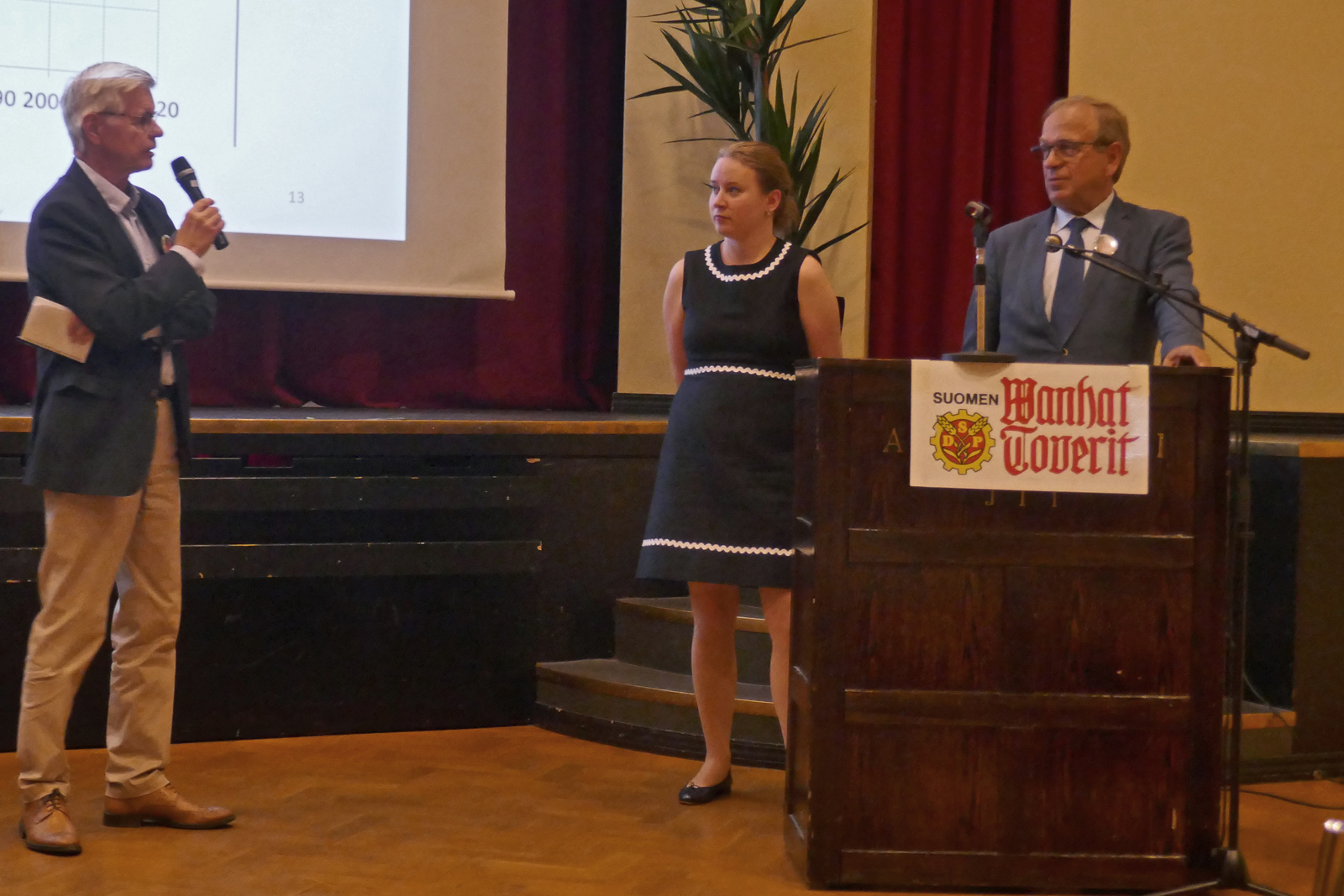
Ilona Lahdelma and Erkki Liikanen being interviewed by Kari Salmi, President of Suomen Wanhat Toverit
Erkki Liikanen
Social democrat veterans met in Jyväskylä in August 2019

We may not be the youngest but we surely have our sights set on the future. And also some really great memories that came back again, from my student activist days in the late 1960’s. Nice moments with old friends and colleagues.

So I am back today from a two-day meeting of the Finnish social democrat veterans association, Suomen Wanhat Toverit. Three hundred we were who came together in Jyväskylä in central Finland on 24 – 25 August 2019. This is an association that brings us together, mostly at local monthly meetings, but every two years at these larger national events. I am an active member there, chairing one of the two local organisations in the Finnish capital, Pääkaupungin Wanhat Toverit.

We met at the Jyväskylä Workers’ Hall, one of the early works of famous Finnish architect Alvar Aalto. Here we were treated to two exceptional presentations about the future of European democracy.

During his long career in politics, Erkki Liikanen was Finance Minister, Member of the European Commission and then Governor of the national bank, and much more. This gives him a unique vantage point on how democracy in Finland, Europe and the world has developed through many periods of challenge and turmoil. In his highly interesting and engaging presentation he raised major challenges but also pointed at positive developments in Europe and the European Union. Tackling marginalisation and improving education have to be among the important tasks on the agenda. The support for the European Union is stronger than ever in many member states which is also a cause for optimism.

Young political scientist Ilona Lahdelma who is working on her doctoral thesis at Oxford University complemented Erkki Liikanens lecture in a way which opened up the subject of democracy itself and offered an attempt to a scientific analysis of some main trends on the European political scene. Her views on how traditional political divides have changed all over Europe was highly interesting. We were also very attentively listening to how political movements must take account of the effects of the new media landscape on voters’ expectations and behaviour.

Meeting old colleagues and friends is a major function of these conferences. All of us have been active in different professional or political roles within the social democratic labour movement. At a dinner which the City of Jyväskylä invited us to old friendships were confirmed in a very pleasant atmosphere. Once again I could feel the benefits of being this pretty small country where our relations tend to be so uncomplicated.

I enjoyed particularly much my long chat with Erkki Liikanen on the train to Jyväskylä. Upstairs in the café wagon it was nice and quiet, almost empty, except for us laughing now and then to some of the common memories from our youth years. Fifty years back we both worked together in the national secondary school student’s organisation Suomen Teiniliitto. This was the central point for Finnish student activism in the late 1960’s – we were in fact often more active and radical than the university students’ associations.

For the first time I heard – I think – Erkki telling me that I was the first Swedish-speaking Finn whom he had ever met. His home town was Mikkeli, in south-eastern Finland, a completely Finnish-speaking region.

We did of course talk about many other things and about today’s world, but this flashback that brought up many nice and even funny incidents and memories was really enjoyable. I could of course write page up and page down on what we were up to during those wild 60’s, maybe I soon will…

Om Europeiska Unionens sociala dimension – artikel i tidningen Eläkkeensaaja sommaren 2018

Finland är bäst I världen säger den ena internationella studien efter den andra. Nöjda och belåtna nickar vi, åtminstone litet grann överlägsna.  Men är det så på riktigt?

Har vi inte något att ta efter de andra EU-länderna. Är det bara frihandeln  och kapitalets rörlighet som är viktigt, och så lantbruksstödet naturligtvis? Och försvarspolitiken?

Nästan en av fem unga människor i Europeiska Unionen är utan jobb. I centrala Östeuropa växer missnöjet. Invandrarna har svårt att integreras i sina nya samhällen. Extrema attityder sprider sig, motsättningarna ökar och gemenskapen försvagas. Ute i världen anges tonen av auktoritära ledare som Trump, Putin och Erdogan.

Nu behövs EU mer än någonsin för att befrämja demokrati, fred och internationellt samarbete.

Europeerna måste sluta upp kring gemenskapen. Det här går bara om EU finns till för människorna i Europa, inte bara för företagen och kapitalägarna.

Redan när den europeiska ekonomiska gemenskapen EEC kom till för 60 år insåg man det här. Tullar och andra handelshinder skulle bort, men också medborgarna måste få sin del av fördelarna. Lantbruksstödet kom snabbt till, och sociala mål skrevs in i EEC:s grundavtal, Rom-fördraget.

Sedan hände inte så mycket annat.

Det var den franska socialdemokraten Jacques Delors som drev igenom en social dimension när han blev den Europeiska kommissionens ordförande år 1985. Då höll Margaret Thatcher i Storbritannien och Ronald Reagan i USA på med att köra ner välfärdssamhället och attackera de fackliga organisationerna. Ändå lyckades Delors föra in välfärdsfrågor på den europeiska agendan och få till stånd en genuin socialdialog mellan arbetsgivarna och facket.   

Under 1990-talet nådde man sedan viktiga resultat, både centralt och inom enskilda branscher. Arbetslivets parter avtalade om deltids- och visstidsarbete, föräldraledighet och distansarbete. Resultaten verkställdes sedan genom europeiska direktiv.

Men sen var det slut igen. Arbetsgivarna var ovilliga att förhandla på riktigt eftersom den politiska och ekonomiska utvecklingen spelade dem i händerna i alla fall. José Manuel Barrosos konservativa EU-kommission gjorde inte heller mycket för att trycka på.

När Jean-Claude Juncker blev kommissionens ordförande år 2014 drev han igenom en ny start för den europeiska socialdialogen. Den moderat konservativa Juncker insåg att de sociala frågorna måste ges en mycket större roll om EU skall kunna hålla ihop och klara av sina enorma utmaningar. Han fick en viktig allierad i Sveriges statsminister Stefan Löfven.

Vid toppmötet i Göteborg i november 2017 skrev man under en ”social pelare” med 20 punkter för mer rättvisa arbets- och sociala villkor och högre levnadsstandard. Samtidigt gav man facket en klar och framträdande roll i beredningen av dessa EU-frågor.

Finland då? Vi har en regering som är fullt sysselsatt med att riva ner den offentliga välfärden och dra mattan under facket, med aktivt stöd från näringslivets organisationer. Den europeiska sociala dimensionen existerar inte i deras tankevärld. 

Det är viktigt för arbetarrörelsen att slå vakt om ett nära samarbete mellan Finland och Sverige för att försvara den nordiska välfärdsmodellen. De framsteg som har gjorts inom EU och den svenska socialdemokratins aktiva roll borde uppmuntra också oss här i Finland.

War veterans village in Finland received the European Broadband Award 2017

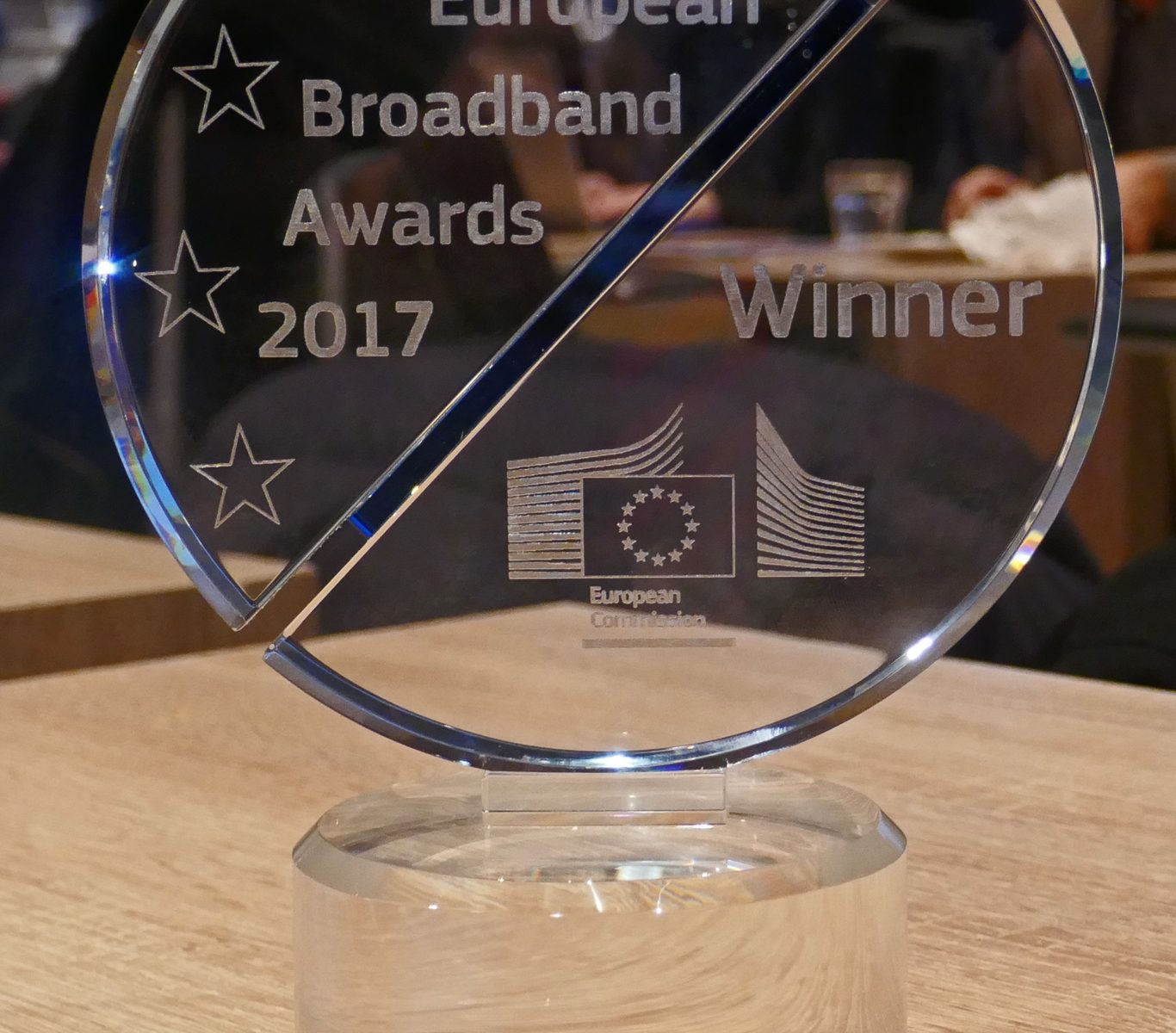
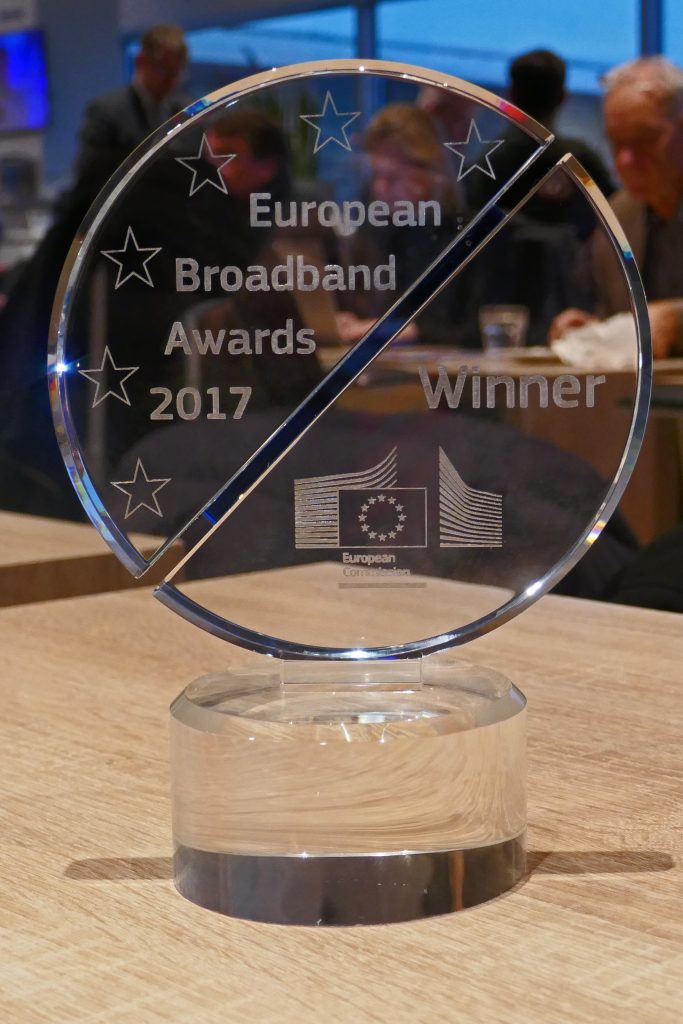
A small village built by war veterans and their families in the 1940s brought home the European Broadband Award 2017. The prize was awarded by three European Commissioners jointly, at a European Union conference and ceremony on 20-21 November. The ”Helsinki Optical Fibre Cooperative” had entered into one of five competition categories, ”Openness and competition”. This was the first time that a Finnish communications network scored the top position.

The broadband network reaches out to most of the almost two hundred family houses in the Marttila Village. 

The First Prize at Brussels airport on its way home to the Marttila village in Pitäjänmäki, Helsinki, Finland.

The EU aim is that ”by 2020, all Union citizens have access to much higher internet speeds of above 30 Mbps and 50 % or more Union households subscribe to internet connections above 100 Mbps.” In Marttila we have already come much further.

The large majority of the 100 plus mainly single family houses in Marttila are connected through a fast and high capacity optical fiber network. It offers symmetric speeds between 100 Mbit/s to 1 Gbit/s. Even higher speeds are possible, and have been tested.

To choose optical fiber instead of relying on wireless connections through one or another of the big telecom operators was clear for us from the beginning. As the mobile phone networks get increasingly congested, which is already happening here in Helsinki at times, connections slow down and become much less reliable.

The connection that I use now is through Telia and gives me speeds clearly above the 100 Mbit/s. The upload speeds that always tend to be much lower are identical to downloads which is a major benefit. Optical fiber is the only sustainable solution that carries far into the foreseeable future.

Much of the work was done by the Marttila village residents themselves.

We also wanted to own and control our own communications. Therefore our cooperative brings four fibers to each home instead of the single one that operator-owned and managed nets do. Multiple telecom operators, large and small, compete and sell their internet services directly to our members using our network.

One of the reasons that we started to build ourselves was the lack of interest by both public and private operators. Government focus is on rural areas and they clearly want urban regions to be built up by commercial actors. The commercial telecom operators are not interested in neighbourhoods like ours which from their point of view are too sparsely populated .

Our village network is the first of its kind in an urban area. It has already inspired followers and other cooperatives have been formed in different parts of the country. We have proved that not only big multinational businesses can build and own communications networks, but also grass-root users themselves.

Of course we were lucky to have some really skilled villagers who were committed to managing and implementing the project with us others. There was a great amount of unpaid voluntary work that made this network accessible for residents. It has contributed much also to the togetherness across the many generations who live in this green oasis in the middle of a large metropolitan area – well it is much more snow-white in the winter…

Jan Furstenborg, member of the Helsinki Optical Fibre Cooperative Board.

Frontmannaby i Helsingfors vann EU-pris för sitt datanät

Europeiska bredbandspriset 2017


En frontmannaby i Sockenbacka i Helsingfors har fått EU:s stora Bredbandspris 2017, i en av fem tävlingskategorier. Priset tilldelades för ett snabbt fibernät som förenar över hundra egnahemshus i området, och som är öppet för priskonkurrens mellan teleoperatörer. 

Vid en ceremoni på en Europeisk datakonferens i Bryssel i början av veckan (20-21.11.) överräckte tre EU-komissionsmedlemmar tillsammans priset till data-aktivisterna från Helsingfors.

Det lilla Sockenbacka-kooperativet väckte positiv uppmärksamhet för både sin initiativrikedom och det goda projektresultatet. Med fyra fibrer till varje hushåll och mycket snabba dataförbindelser är nätet redan nu långt över de mål som EU har ställt upp för de kommande åren.

De flesta övriga deltagarna i tävlingen var ministerier eller privata storföretag. Projekten var ofta EU-finansierade och datatjänsterna begränsade till en teleoperatör. Det finländska kooperativet är däremot helt finansierat av invånarna själva. Kostnaderna har hållits nere genom ett omfattande frivilligarbete både inom projektledning och nätverksbygge. 

Det prestigefyllda bredbandspriset – European Broadband Awards – tilldelas vartannat år till de fem bästa projekten i medlemsländerna. De två andra finalisterna i sockenbackabornas kategori var Ungerns utvecklingsministerium och en stor irländsk teleoperatör, båda med internationellt finansierade jätteprojekt. fff