Helsinkiläisen rintamamieskylän laajakaista-aktivistit voittivat EU-palkinnon


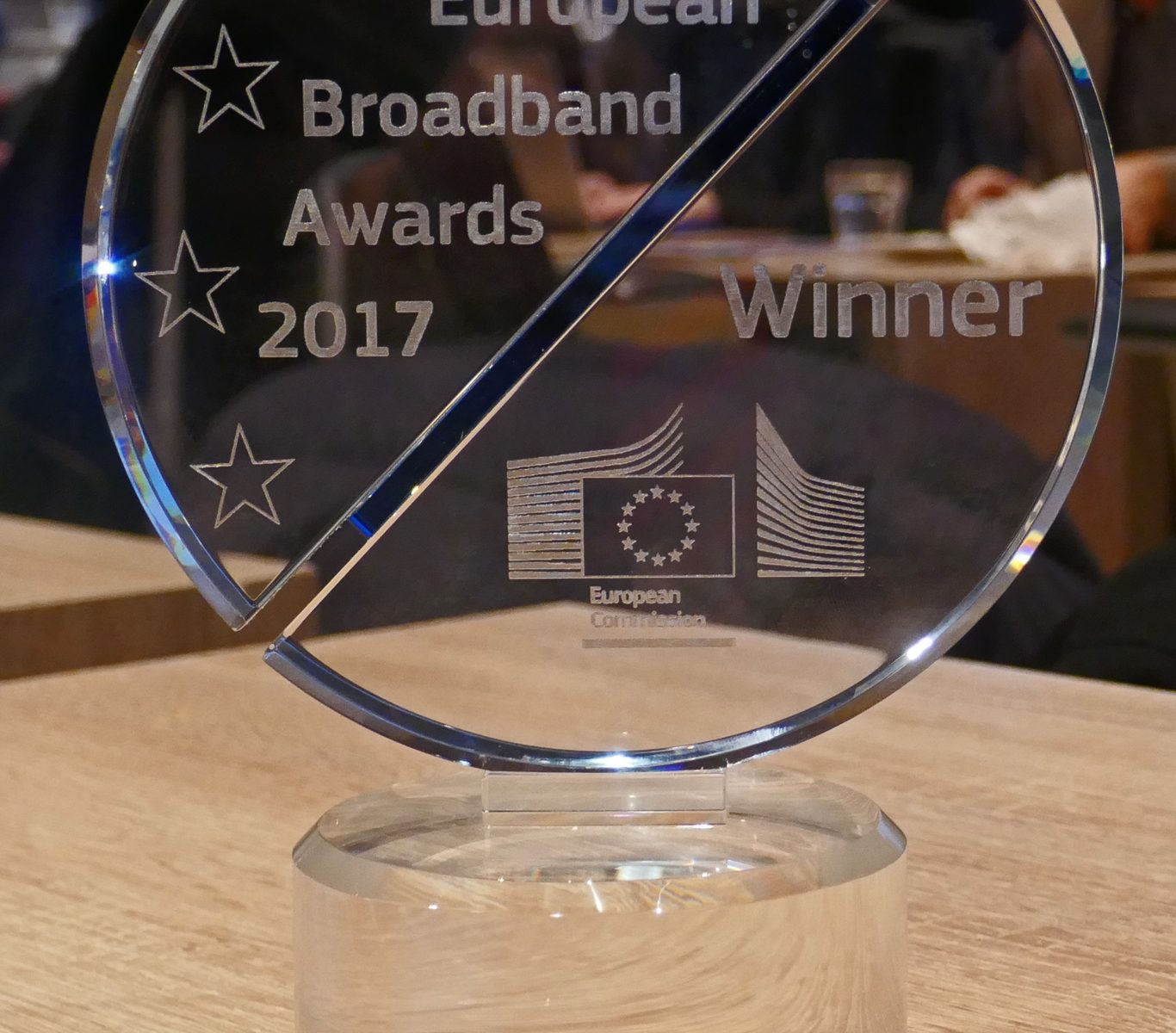
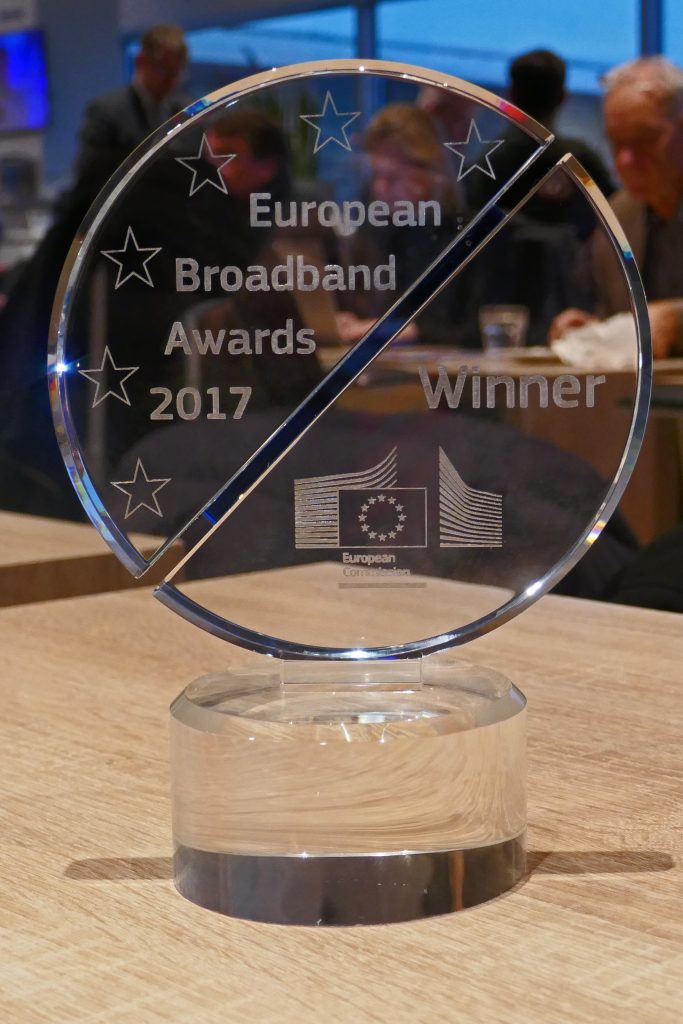
Euroopan Unionin laajakaistapalkinto 2017

Marttilan kylä Helsingin Pitäjänmäellä on voittanut Euroopan Unionin suuren Laajakaistapalkinnon 2017. Ensimmäisenä suomalaisena tietoliikennehankkeena kyläläisten itse rakentama nopea kuituverkko voitti yhden viidestä viidestä kilpailusarjasta.

Brysselissä alkuviikolla (20-21.11.) pidetyssä suuressa laajakaistakonferenssissa luovuttivat kolme Euroopan Komission jäsentä yhdessä ensimmäisen  palkinnon pitäjänmäkeläisille aktivisteille.

Pieni helsinkiläinen osuuskunta herätti omatoimisuudellaan ja projektinsa toteutuksella erityistä huomiota kilvassa jossa muut osanottajat olivat yleensä joko ministeriöitä tai monikansallisia toimijoita. Monet näistä 

Rintamamieskylään rakennettu nopea valokuituverkko kattaa toistasataa kotia ja on myös tekniseltä suorituskyvyltään ylivoimainen verrattaessa jopa EU:n asettamiin lähivuosien kehitystavoittaisiin.

Arvostettu laajakaistapalkinto – European Broadband Awards – kilpailutetaan joka toinen vuosi EU:n jäsenmaissa toteutettujen projektien kesken. Osuuskunta Helsingin Valokuidut oli ilmoittautunut kilpailukategoriaan jossa edellytettiin avoimen kilpailun edistämistä palveluntarjoajien kesken.

Loppusuoralla Marttilan kylän tietoverkon kanssa finalisteina kilpailivat unkarilainen ministeriö ja suuri irlantilainen tietoliikkenneyritys.

Unhappy with wireless connections Helsinki Finland neighbourhood built its own super-fast fiber network

The resident-owner cooperative fibre network in the Marttila village in Helsinki has been built by residents themselves at their own expense without any public support from Finland or the European Union.
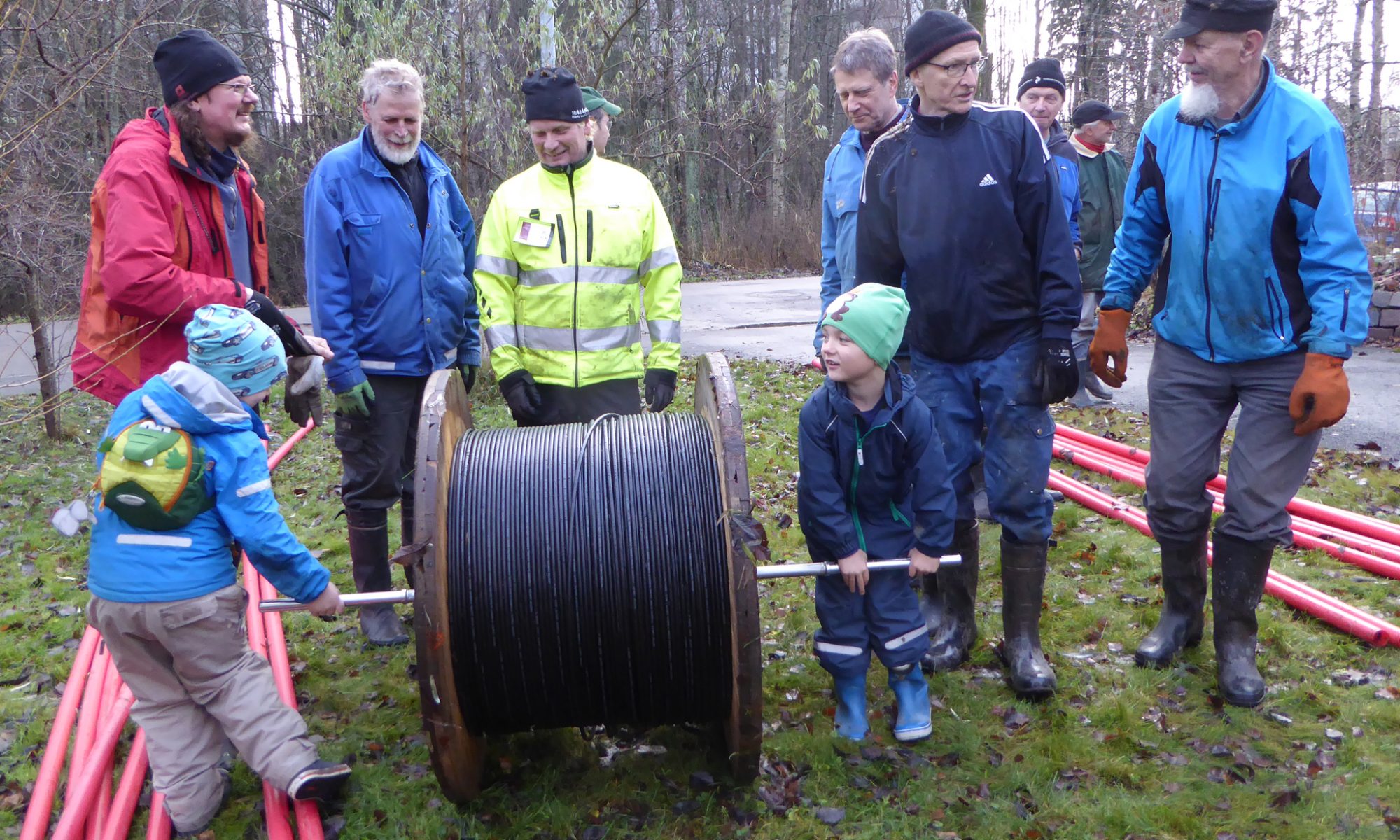
Laying the cable on a rainy autumn day in Marttila, in its protective tube. Four fibres reach every participating home and the network is resident owned. This means that there will always be competition between service providers instead of a local monopoly which is the usual situation.
  1. When I write this, the European Parliament is discussing EU support to internet connectivity in rural areas. This is good and important.
  2. The aim is that ”by 2020, all Union citizens have access to much higher internet speeds of above 30 Mbps and 50 % or more Union households subscribe to internet connections above 100 Mbps.”
  3. In Marttila – my small village in Finnish Capital Helsinki – we have already reached this, and indeed even more. This has been done entirely at our own expense, without any outside support. Much of the work has been contributed by villagers on a voluntary non-paid basis.
  4. The cooperative owned Marttila network is not large by any measure, and the homes in the village are pretty modest. They were built on city owned land in the late 1940s, by and for war veterans.
  5. The large majority of the 100 plus mainly single family houses in Marttila are now connected through a fast and high capacity optical fiber network. It offers symmetric speeds between 100 Mbit/s to 1 Gbit/s. Even higher speeds are possible, and have been tested. I doubt that many would have opted for the few lower speed alternatives that are available…
  6. To choose optical fiber instead of relying on wireless connections through one or another of the big telecom operators was clear for us from the beginning. As the mobile phone networks get increasingly congested, which is already happening here in Helsinki at times, connections slow down and become much less reliable.
  7. The connection that I use now is through Telia and gives me speeds clearly above the 100 Mbit/s. The upload speeds that always tend to be much lower are identical to the downloads which is a major benefit. Imagine the improvement for a friend of mine here who is a graphical artist and who now can be sure that hid works rapidly fly off to their destination without having to slowly grind for ages. So, optical fiber is the only sustainable solution that carries far into the foreseeable future.
  8. We also wanted to own and control our own communications. This is now reality as our cooperative brings four fibers to each home instead of the single one that operator-owned and managed nets do. Multiple telecom operators, large and small, sell their internet services directly to our members over our network that connects to theirs.
  9. One of the reasons that we started to build ourselves was the lack of interest from others to do anything here. The European Union or the Finnish government focus on rural areas and want urban regions to be built up by commercial actors. The telecom operators on their side are uninterested as neighbourhoods like this are sparsely populated from their point of view.
  10. The village network is interesting also as it is the first of its kind in an urban area. Today it proves that not only big multinational businesses can build these networks but also grass-root users themselves.
  11. Ok, of course we were lucky to have some really skilled neighbours who were committed to the project and who have done a great unpaid voluntary work for us all. Great contribution also to the togetherness across the many generations who live in this green oasis – ok it is much more snow-white in the winter…

Time for Europe to resolve the Greek debt issue


Time to resolve the Greek debt issue!

The rather disrespectful language and misguided statements that soured early stages of discussions and negotiations have of course not been helpful for building confidence. Now the tone seems to be changing and attention shift to seeking concrete solutions. This is how it should be.

We have seen that Germany’s social democrats believe that the latest proposal from Athens gives a good basis for this. They also distance themselves from the most hardline conservative opinions. Vice Chancellor and SPD President Sigmar Gabriel has said this clearly.

Europe’s other social democratic movements, including in my own country Finland, should join in working for an end to the yes-no debate, together with moderate conservatives and others. I am sure that this will happen.

It is not always easy for people in the Eurozone countries to accept added liabilities when they themselves are squeezed by recession and unemployment. In Finland, also the decline of the Russian Rouble and the mutual sanctions hit hard on economy and employment and add to the strains.

The new Greek government’s declared commitment to respect its obligations and to build up a sound economic administration and taxation was both necessary and welcome with a view of seeking political acceptance among these voters for a final agreement.

Others must now also understand that changes are needed in Greece itself to alleviate the situation of those who are the weakest and most badly hit while supporting the growth that is necessary for the longer term building up of the economy.

The economic dimension is of course highly important for the Eurozone tax payers who are backing up the recovery programme, but let us not forget that the European Union is about much more.

Already a look at the map of Europe should convince anyone about the importance of a stable and democratic Greece in the south-east where the political and social situation is far from settled.

Together with the Nordic ties it defines also Finland’s place in the world. For many of us this was the key reason when we voted for EU membership. Today we need to strengthen the community, not weaken it.

Portugal visit and old memories coming back – reminded me again of the need for Europe to stick together

A few days ago I came back from a week in Portugal, this time on an autumn holiday. The pleasant visit brought back many memories from my many visits to this beautiful country. Atlantic, not Mediterranean, and this one can both see and feel.

The first time I was there was in 1975 when the Salazar dictatorship had just been overthrown and the country’s trade unions could once again celebrate a free First of May. I brought the greetings of the Finnish trade union confederation to a huge manifestation in Porto, speaking to a crowd of quarter of a million that filled all open spaces and narrow streets in the historical old town.

The Portuguese trade unions also hosted a major athletics event at the stadium in Lisbon. They asked me to assist in the medal ceremony for 10,000 meters as I came from Finland with its glorious (but old) traditions. The winner Carlos Lopes to whom I presented the gold medal was to go on and take silver on 5,000 meters at the Montreal Olympics the following year, after Finland’s (!) Lasse Virén. Later he won the Olympic gold medal in Los Angeles in 1984, in marathon.

A few years later I was in Portugal again with my Nordic  trade union colleagues. The first euphoria had calmed down, for good and worse, and the country was struggling with very concrete everyday challenges.

This was a period in Portugal which was filled by celebration and eagerness to build up a new kind of society after the harsh years of the dictatorship. One can only hope that the country will get over its present economic and thus also social problems and go towards a good future. These are hard working people who have already overcome so many problems that one can be optimistic about this.

My years at UNI then brought me back several times, and it was always very pleasant and inspiring to work and spend time with the Portuguese colleagues. They were also regular and active participants in the European Union social dialogue in commerce.

This most recent visit convinced me, once again, that the European Union needs to stick together and face the challenges that we have in a spirit of solidarity and mutual support. There have been times and occasions when my own country Finland needed – and also got – support from the outside world.

Sticking together is also a part of our common identity as Europeans, which is more valuable than we often remember to reflect on.

Spain’s big store retail employers need to bring their labour relations to EU levels and respect freedom of association

Large retailers  in Spain should take a look in the mirror, and then start to get their labour relations act together. The recent deal with management controlled ‘trade unions’ makes bad worse for hundreds of thousands of low-paid workers already badly squeezed by the crisis.

When I was head of UNI Commerce Global Union, the labour situation in some of the department store and hypermarket companies in Spain stuck out as something of a sore thumb. Violations of workers rights and disregard for freedom of association were part of the daily lives at many workplaces.

We see the same now when large retailers have signed collective agreements with sweetheart unions to cut wages, extend working hours, and take away other benefits. Once again it is the same employers’ organisation ANGED that is there doing the job for them, influenced by the country’s largest retailer El Corte Ingles, and some others.

Sad, because in supply chain corporate social responsibility this huge department store and hypermarket retailer is one of the most active companies.

To make some of the most disadvantaged workers pay for the country’s crisis economy is highly unfair. Recently we saw reports of huge undeclared payments from large Spanish companies to leaders of the governing Popular Alliance AP party of Prime Minister Mariano Rajoy. It is difficult to accept that at the same time workers at the lowest income levels are squeezed even more by huge and profitable companies.

The two Spanish commerce trade unions FECOHT-CCOO and FECHT-UGT estimate that the agreement signed with FETICO and FASGA could cost some 230,000 workers an average of 10 percent of their incomes. Almost all of them are low-paid and very many on temporary contracts, frequently in part- time jobs.

For many years, I worked with the Spanish unions – and also many constructive European employers – to try to change this situation and to establish normal European labour relations.

At times we made real progress. Still, the results could finally not be sustained, particularly because of the determination of a hard core of them to keep up old bad practices. Politics also played a role. It was not difficult to see the close ties between Spanish management and the party of the conservative right.

Trade unions that re-emerged in the 1970s after decades of harsh repression during the Franco dictatorship had to be stopped, that was the target. In most sectors  old organising traditions and the new political environment made this impossible. Not so in retailing which lacked strong union traditions. Here El Corte Ingles and some others moved fast to fill the vacuum left by the Francoist vertical structures, creating new ‘sweetheart ‘unions’. As large foreign retailers began entering later, they were usually pulled into the same fold.

This anomaly still exists in Spain. The two ‘yellow unions’ Fetico and FASGA cooperate openly with management and are often used by the employers as willing tools. All attempts to change this from within have decisively been cut short through management intervention, and independence-minded Fetico leaders have lost their positions. I met some of them during my UNI years, but their plans – however serious they then were – proved to be impossible to realise.

I also visited department stores and hypermarkets during works council elections and could see some of the blatant violations taking place. I saw voters intimidated, candidates put under pressure to sign off, and the polling secret violated.

Twice I witnessed harsh supervisor pressure on workplace candidates, making them break down in tears and remove themselves from the ballots, afraid of losing their jobs. The aim was to disqualify the union list through making the number of candidates fall under set limits.

In a large department store workers had to walk up through a narrow staircase to the polling station, passing groups of young men – reportedly from FASGA – in dark suits standing along the way. Voters had to pick up ballot papers from stacks on a desk where an election board was sitting, different colours for the different union lists. No wonder if many of them chose to pick up only the one with the employer’s favourite colour.

Of course, I met and saw companies and workplaces where there was a reasonably honest competition between the organisations and their candidates, also some where Fetico got the biggest support. So there is no reason that this should not work in Spain as it does in the rest of the EU?

Differences and labour conflicts between employers and trade unions are normal and acceptable, and most countries have clear rules on how to resolve them. Sometimes employers are unreasonable, and at other times trade unions are unrealistic in their demands. This is normal as well, and usually a result will finally be found – perhaps not popular with either party, but they can live with it.

We have to remember that this is not a political organisation game, but about how human beings at workplaces are treated. Pressure and intimidation of workers and workers’ representatives is not only illegal and a violation of International Labour Standards. It is also ethically and morally wrong.

I will not go into the details of the agreement itself. My view is that it is both unwise and unfair to clamp down even harder on those who are already worst hit by Spain’s economic troubles and extreme unemployment. This will not help recovery or promote the social peace and political stability that both Spain and the European Union need.

It is time to reflect and turn around the bad spiral of deteriorating labour relations in this important sector of Spanish retailing. The responsibility for this is now clearly with the employers, both domestic and foreign. They need to take steps to recall their local human resources management and this particular association to order.

New kids on the CSR block are popular and interesting – but ILO Conventions remain the core reference for supply chain social responsibility

The UN Guiding Principles for Business and Human Rights is an important and welcome addition to handling supply chain labour relations. Governments and buyers are reminded of their human rights responsibilities.

Not so good are the attempts to market it as the new main reference for supply chain social responsibility. This role will stay with the tripartite International Labour Organisation ILO and its International Labour Conventions.

Professor John Ruggie and his Harvard University based team did a big service for universal human rights when they produced a new social responsibility building block that adds to the UN Global Compact, the OECD Guidelines for Multinational Companies, the ILO Multinationals Guidelines, and other international agreements and recommendations.

The UN Guidelines both support and encourage the business driven and multistakeholder voluntary schemes and initiatives which work for social responsibility in the global supply chains. They call on buyer brands and retailers to take responsibility also for their suppliers’ human rights related action. This can add to the coverage, relevance and credibility of the voluntary initiatives.

The guidelines should encourage also those businesses who are still passive to join one of the many schemes or to launch their own initiatives.

The UN principles have been picked up by the OECD in a recent revision of their guidelines, and will surely find their way also to the ISO 26000 Standard once it will be reviewed.

On the business driven or multi-stakeholder CSR arena at least the Global Social Compliance Programme ( GSCP ) Reference Code and the Social Accountability International ( SAI ) SA8000 Social Standard will soon be up for scheduled updating, and can be expected to pick up some principles and approaches from the UN Guidelines.

These Guidelines that have been endorsed by the UN Human Rights Council in 2011 do not cover all the issues that are important for supply chain workers. The protect, respect, remedy approach focuses on human rights while many essential labour conditions fall outside.

The document recognises freedom of association and the right to collective bargaining, and the other Core Labour Conventions, but does not really address worker empowerment and involvement. Here, the core ILO Conventions and Recommendations give more concrete guidance – and rules.

In no way does this lower the value of the UN Guidelines. They are an important tool for promoting human rights, both at work and in other areas where businesses have an impact on peoples’ lives. Demanding due diligence from brands and  retailers in their global supply chains brings a new dimension to what has been driven by activist pressure and consumer opinion.

Also the ISO 26000 Standard can contribute to corporate social responsibility, as a useful tool particularly for larger companies. It could bring CSR values higher up on corporate agendas and encourage to the due diligence expected by the UN Guidelines.

The Standard is pretty complicated and not available for free. This is a treshold for many and create a lack of transparency, and thus credibility. It is somewhat hard to see how useful the ISO 26000 can really be when dealing with global supply chains.

Let us also remember that this standard does not set working life norms, this was agreed at an early stage between ISO and ILO. A company cannot be certified for compliance with the Standard. This has been made clear by the ISO itself and any certification approaches are business activities of commercial auditors and consultants.

Politicians have been fast to respond to all these CSR developments, which of course is good. Regrettably, the recent European Parliament resolution bore the fingerprint of activists who wanted to promote their own project work. This was not the right context for that, whatever one thinks about the suggested project itself. We will surely see some changes in it when it moves further through the EU machinery.

Also in the United States, the government is on the move. Bangladesh has been warned that unless they get their house in order when it comes to work safety in the garment factories, they may lose their trade privileges.

Still, something has not changed and should not change. That is the agreed and established principle that international labour norms are set by the International Labour Organisation ILO, and by ILO only.

The ILO is the only United Nations organisation where employers and trade unions work alongside governments, for the common aim to ensure decent working conditions around the globe. International Labour Conventions remain the global constitution for working life. This is correctly acknowledged in all the other guidelines as well as by the voluntary CSR schemes and initiatives.

Only ILO Conventions are enforceable in the way that governments have a formal responsibility to see that they are implemented in full in their countries. The core conventions that address human rights issues do not even have to be ratified, they bind all member countries. Governments that do not take their responsibility for this can be sanctioned, although that would be extremely rare.

Even more important is that the mainstream labour relations system builds on social dialogue and collective agreements between workers and their trade unions, and the employers. Already the ILO process itself reflects this principle which should be carefully defended.

The new kids on the block can bring much added value, but their work can also be used to support paternalist approaches, which should not be supported.