Heat wave is drying out our local creek Mätäjoki in Pitäjänmäki Sockenbacka in Helsinki

The prolonged heat wave is slowly drying up the Mätäjoki creek that runs through our Marttila village in Pitäjänmäki Helsinki. This used to be an ancient route up from the sea which monks from the Baltics used already in the middle ages. The uplift of land that started after the Ice Age and still slowly continues has of course had its own effect.

If the name of the creek is translated directly into English it would be the Rotten River. For long I thought it was indeed so that the rather unflattering name with its not so nice connotations had its reasons.

Only this year I heard from a city expert that this is in fact a misunderstanding. The Swedish name Rutiån from which the Finnish one has been adapted is actually not based on ’rotten’ – that is ’rutten’ – but comes from an ancient and forgotten German word for a dog…

So we learn something every day.

The hot weather continues here with daily temperatures up to 30C. Luckily we have been spared from the kind of huge forest fires that ravage Sweden but the risk is always there.

In this (still) bilingual Finland also most names exist in the two national languages. This means that Helsinki is Helsingfors, the city region Pitäjänmäki is Sockenbacka and the Marttila village is Martas in Swedish.

Moving freely in the woods collecting mushrooms – healthy luxury life in Finland

Great day for a walk in the Finnish forest – and collecting mushrooms. This is the time for funnel chanterelles or winter mushrooms as they are sometimes also called. And yes, here in Finland one is free to move in the terrain, private and public, just staying at a respectful distance from the very immediate surroundings of peoples’ homes.

Much of the forest areas are also still owned by the government, the present coalition has not yet succeeded to sell them abroad in their privatizing frenzy…

The rather small funnel chanterelles are hard to detect but once found they tend to flock in large numbers around the same place. Today’s excursion was to a forest area some 30 kms east of Finnish capital Helsinki. And no, we neither saw nor heard anyone else out there during the 3 hours stay, only heard some distant bird sounds.

War veterans village in Finland received the European Broadband Award 2017

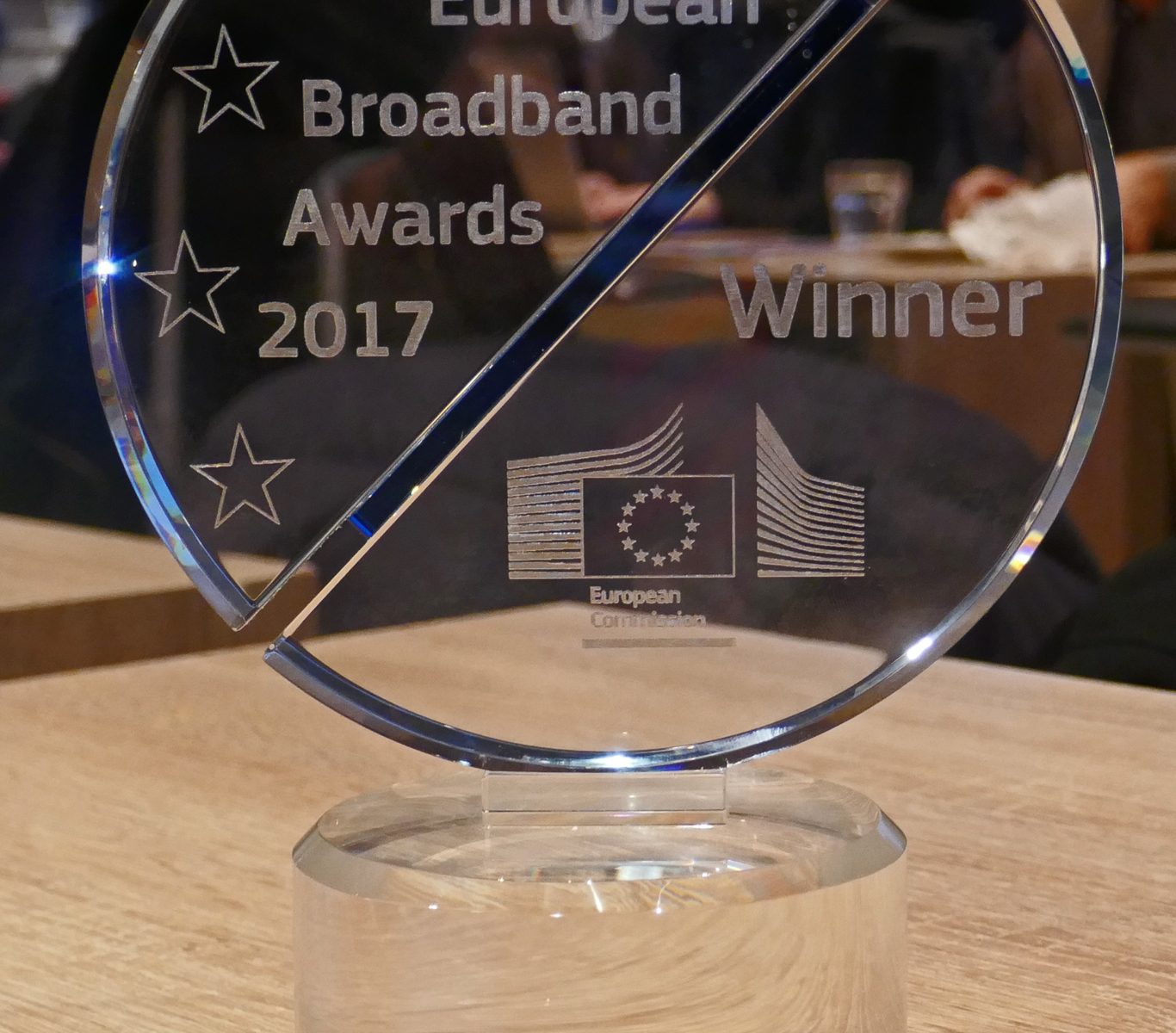
A small village built by war veterans and their families in the 1940s brought home the European Broadband Award 2017. The prize was awarded by three European Commissioners jointly, at a European Union conference and ceremony on 20-21 November. The ”Helsinki Optical Fibre Cooperative” had entered into one of five competition categories, ”Openness and competition”. This was the first time that a Finnish communications network scored the top position.

The broadband network reaches out to most of the almost two hundred family houses in the Marttila Village. 

The First Prize at Brussels airport on its way home to the Marttila village in Pitäjänmäki, Helsinki, Finland.

The EU aim is that ”by 2020, all Union citizens have access to much higher internet speeds of above 30 Mbps and 50 % or more Union households subscribe to internet connections above 100 Mbps.” In Marttila we have already come much further.

The large majority of the 100 plus mainly single family houses in Marttila are connected through a fast and high capacity optical fiber network. It offers symmetric speeds between 100 Mbit/s to 1 Gbit/s. Even higher speeds are possible, and have been tested.

To choose optical fiber instead of relying on wireless connections through one or another of the big telecom operators was clear for us from the beginning. As the mobile phone networks get increasingly congested, which is already happening here in Helsinki at times, connections slow down and become much less reliable.

The connection that I use now is through Telia and gives me speeds clearly above the 100 Mbit/s. The upload speeds that always tend to be much lower are identical to downloads which is a major benefit. Optical fiber is the only sustainable solution that carries far into the foreseeable future.

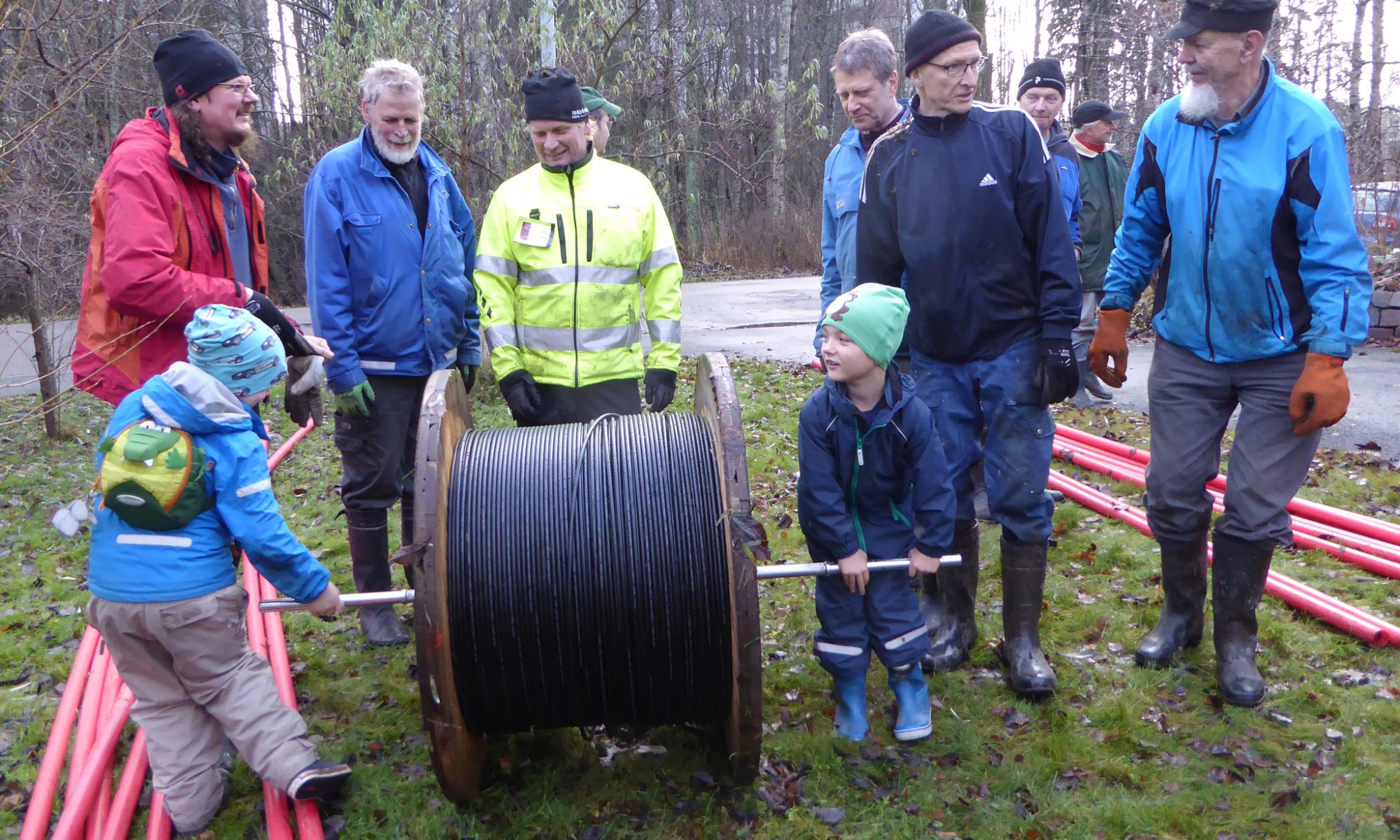
Much of the work was done by the Marttila village residents themselves.

We also wanted to own and control our own communications. Therefore our cooperative brings four fibers to each home instead of the single one that operator-owned and managed nets do. Multiple telecom operators, large and small, compete and sell their internet services directly to our members using our network.

One of the reasons that we started to build ourselves was the lack of interest by both public and private operators. Government focus is on rural areas and they clearly want urban regions to be built up by commercial actors. The commercial telecom operators are not interested in neighbourhoods like ours which from their point of view are too sparsely populated .

Our village network is the first of its kind in an urban area. It has already inspired followers and other cooperatives have been formed in different parts of the country. We have proved that not only big multinational businesses can build and own communications networks, but also grass-root users themselves.

Of course we were lucky to have some really skilled villagers who were committed to managing and implementing the project with us others. There was a great amount of unpaid voluntary work that made this network accessible for residents. It has contributed much also to the togetherness across the many generations who live in this green oasis in the middle of a large metropolitan area – well it is much more snow-white in the winter…

Jan Furstenborg, member of the Helsinki Optical Fibre Cooperative Board.

Unhappy with wireless connections Helsinki Finland neighbourhood built its own super-fast fiber network

The resident-owner cooperative fibre network in the Marttila village in Helsinki has been built by residents themselves at their own expense without any public support from Finland or the European Union.
Laying the cable on a rainy autumn day in Marttila, in its protective tube. Four fibres reach every participating home and the network is resident owned. This means that there will always be competition between service providers instead of a local monopoly which is the usual situation.
  1. When I write this, the European Parliament is discussing EU support to internet connectivity in rural areas. This is good and important.
  2. The aim is that ”by 2020, all Union citizens have access to much higher internet speeds of above 30 Mbps and 50 % or more Union households subscribe to internet connections above 100 Mbps.”
  3. In Marttila – my small village in Finnish Capital Helsinki – we have already reached this, and indeed even more. This has been done entirely at our own expense, without any outside support. Much of the work has been contributed by villagers on a voluntary non-paid basis.
  4. The cooperative owned Marttila network is not large by any measure, and the homes in the village are pretty modest. They were built on city owned land in the late 1940s, by and for war veterans.
  5. The large majority of the 100 plus mainly single family houses in Marttila are now connected through a fast and high capacity optical fiber network. It offers symmetric speeds between 100 Mbit/s to 1 Gbit/s. Even higher speeds are possible, and have been tested. I doubt that many would have opted for the few lower speed alternatives that are available…
  6. To choose optical fiber instead of relying on wireless connections through one or another of the big telecom operators was clear for us from the beginning. As the mobile phone networks get increasingly congested, which is already happening here in Helsinki at times, connections slow down and become much less reliable.
  7. The connection that I use now is through Telia and gives me speeds clearly above the 100 Mbit/s. The upload speeds that always tend to be much lower are identical to the downloads which is a major benefit. Imagine the improvement for a friend of mine here who is a graphical artist and who now can be sure that hid works rapidly fly off to their destination without having to slowly grind for ages. So, optical fiber is the only sustainable solution that carries far into the foreseeable future.
  8. We also wanted to own and control our own communications. This is now reality as our cooperative brings four fibers to each home instead of the single one that operator-owned and managed nets do. Multiple telecom operators, large and small, sell their internet services directly to our members over our network that connects to theirs.
  9. One of the reasons that we started to build ourselves was the lack of interest from others to do anything here. The European Union or the Finnish government focus on rural areas and want urban regions to be built up by commercial actors. The telecom operators on their side are uninterested as neighbourhoods like this are sparsely populated from their point of view.
  10. The village network is interesting also as it is the first of its kind in an urban area. Today it proves that not only big multinational businesses can build these networks but also grass-root users themselves.
  11. Ok, of course we were lucky to have some really skilled neighbours who were committed to the project and who have done a great unpaid voluntary work for us all. Great contribution also to the togetherness across the many generations who live in this green oasis – ok it is much more snow-white in the winter…

Ending employer repression of Bangladesh garment workers is a common task for buyers and unions

When large parts of the world were celebrating their year-end holidays, the Bangladesh garment manufacturers went on offensive against their workers. Over 1,600 lost their jobs and production at numerous facilities was halted as a repressive lock-out measure while several union leaders and worker activists were detained by police or driven into hiding. This ended strike action for a substantial rise to the country’s sub-standard 68 US Dollar monthly minimum wage.

At European sustainability conferences the Bangladesh Garment Manufacturers and Exporters Association BGMEA has liked to present itself as a modern employers’ association, respecting workers’ rights, including freedom of association. The picture has now been shattered by mass dismissals and police repression taking the place of constructive negotiations and social dialogue.

This has not necessarily been a surprise. We should not cheat ourselves by believing that fundamental changes in working life attitudes could appear over night in problematic producer countries. Respect for human rights at work grows slowly, at its best. For many years to come we will need outside involvement and pressure to develop and secure decent labour conditions. Trade regulations and socially responsible buyer policies remain the main tools for this.

Building and fire safety programmes are not enough

The building and fire safety programmes that were imposed on the industry after the Rana Plaza disaster have already improved numerous factory workplaces. This is an important achievement by both the European-dominated Accord and the US-based Alliance. Regrettably, a common project could not be reached.

Although workers’ and trade union rights are part of their agendas – particularly so within the Accord – their core tasks do not cover overall labour conditions. This is the role of other projects such as the Bangladesh Sustainability Compact  which brings together the European Union, the United States ( we will see then what happens with Donald Trump in the lead in Washington DC ) , Canada, the ILO and Bangladesh itself. It is complemented by the Decent Work in Bangladesh and the Better Work Bangladesh programmes, as well as by many other initiatives and activities.

Between 2013 and 2015, the Bangladesh Government put in place improved legislation on guarantee freedom of association, supported by the International Labour Organisation ILO. There are also national tripartite consultation mechanisms. Still, it would be be unrealistic to think that labour problems are solved when laws and regulations are updated and improved. There must also be a capacity and political will to apply the new principles. While resources could be built up reasonably fast, changes to social cultures and attitudes take much longer.

Buyers share the responsibility to act

International buyer brands and retailers sourcing or producing in Bangladesh cannot just close their eyes for what is happening now. The wage raise numbers can and should of course be discussed locally, but it is clear that the official minimum wage is seriously below what is acceptable for living costs. While it may not be the role of buyer corporations to involve themselves directly in wage negotiations, they do have a responsibility to intervene if freedom of association and the effective right to collective bargaining are violated. Labour conflicts should be settled in negotiations, not by police intervention and repression.

All serious social sustainability codes and standards require suppliers to pay wages that cover basic living costs and provide for some discretionary expenses. Some call it a living wage, some don’t, but it is always there. This is the time, if ever, for buyers to activate this and to get involved in  suitable ways.

Instead of deducting from the importance of sustainability, the rise of populism in buyer countries may add to it. There is a strong and forceful counter-reaction bringing people together in  new ways. Leading brands and buyers should not lose sight of the consumer powers of these people whose consciousness is growing as they engage in a fight for human and democratic values. Supply chain condition will continue to be in the public eye however government policies may change. Businesses need to overcome the all too common emotional and ideological aversions against working with trade unions on supply chain issues and accept that social  dialogue and cooperation builds a positive and even necessary engagement and stability.

Improved supply chain cooperation needed between business and trade unions

Also many global unions and non-governmental organisations could do some rethinking. Instead of attacking the sustainability schemes and initiatives they should be engaged to help bring about real and positive change. Without initiatives such as BSCI, SAI and its SA8000 Standard, WRAP, Fairtrade and others, control and remediation activities on the ground would be really thin. The social auditing industry which recently launched and important development effort through APSCA – the Association of Professional Social Compliance Auditors – will continue to play an essential role in making sustainable development possible.

On their own, unions and NGOs will not be able to generate real improvements, in an increasing unsympathetic world where hard business values and right-wing  populism continue to gain ground also among decision-makers. This is the time for pragmatic and mutually rewarding supply chain alliances, however conflicting the interests may be on other arenas.